







In an era where naval dominance hinges on digital supremacy, the U.S. Navy’s integration of high-speed internet represents both a tactical edge and a formidable vulnerability. Imagine a fleet of warships slicing through the Pacific, their systems humming with real-time data feeds from satellites and sensors, enabling everything from drone strikes to crew morale via video calls home. Yet, this connectivity powered by low-Earth orbit (LEO) networks like Starlink opens doors to adversaries probing for weaknesses. As cyber threats evolve, cybersecurity high speed internet US Navy operations face unprecedented challenges, from legacy system hacks to state-sponsored espionage. This isn’t just a technical issue; it’s a strategic imperative. With over 560,000 users relying on the Navy’s Flank Speed cloud service, a single breach could cripple missions, leak classified intel, or even endanger lives at sea. Understanding these hurdles is crucial for sailors, policymakers, and industry partners alike, as the Navy pushes toward zero-trust architectures amid rising global tensions.
The Evolution of High-Speed Internet in US Navy Operations
The U.S. Navy’s journey with high-speed internet began as a morale booster but has transformed into a cornerstone of operational readiness. Historically, ships relied on geostationary satellites delivering a mere 1-2 megabits per second barely enough for email, let alone video streams. Enter the Sailor Edge Afloat and Ashore (SEA2) program, which leverages commercial LEO satellites from providers like SpaceX’s Starlink and Eutelsat OneWeb. These systems promise up to 1 Gbps speeds, a 20-fold leap, allowing terabytes of data to flow daily for maintenance logs, F-35 mission updates, and remote cybersecurity scans.
This shift isn’t without precedent. The Navy’s Flank Speed initiative, a Microsoft-partnered zero-trust cloud, already serves global users with secure access to tools like Office 365. But SEA2 takes it further, blending commercial cellular (4G/5G) with satellite links for resilient connectivity. During the USS Abraham Lincoln’s 2024 Red Sea deployment, sailors streamed the Super Bowl in HD for the first time, while tactically downloading combat system updates over-the-air proving high-speed internet’s dual role in boosting retention and enabling software-defined warfare. As Rear Adm. Doug Small of NAVWAR noted, “This is a once-in-a-lifetime transformation for the warfighter.”
Yet, this evolution amplifies risks. Expanded attack surfaces from commercial networks invite sophisticated threats, demanding layered defenses. The Navy’s adoption of proliferated LEO (P-LEO) isn’t just about speed; it’s about outpacing adversaries in a contested electromagnetic spectrum.
What Internet Does the Military Use?
Delving deeper, what internet does the military use? The U.S. military operates a hybrid ecosystem far removed from civilian broadband. At its core is the Defense Information Systems Network (DISN), a global mesh of secure, packet-switched networks including the Non-classified Internet Protocol Router Network (NIPRNet) for unclassified traffic and the Secret Internet Protocol Router Network (SIPRNet) for secret-level data. These evolved from ARPANET, the internet’s military precursor, ensuring encrypted, resilient comms across bases, ships, and aircraft.
For afloat forces, legacy VSAT terminals tied to six geostationary satellites sufficed for basic needs but lagged in bandwidth. Today, the Navy supplements with commercial options under strict oversight. The SEA2 program’s network-agnostic design integrates military SATCOM like the Mobile User Objective System (MUOS) with civilian LEOs, prioritizing low latency for drone control and AI-driven analytics. Deployed troops access via satellite hotspots or base Wi-Fi, often filtered through tools like the Army’s Enhanced Hotspot program secure but capped for personal use.
This blend addresses what internet does the military use in practice: a fortified backbone for command-and-control, fused with agile commercial layers. However, it underscores vulnerabilities; unauthorized setups, like the 2024 Starlink breach on USS Manchester, highlight how “tolerated” links can bypass protocols, creating electronic footprints for foes.
How Fast is Verizon Internet in Military Contexts?
When discussing speeds, how fast is Verizon internet? As a key DoD partner, Verizon Fios delivers fiber-optic plans from 300 Mbps to 2 Gbps downloads, with uploads matching at gigabit tiers ideal for high-demand simulations or remote ops. In military applications, Verizon’s 5G Home edges out at 300-1,000 Mbps, powering base networks via the Commercial Cellular at the Tactical Edge (CCaaT) program. This enables low-latency ship-to-shore links, but real-world tests show variances due to congestion, averaging 85-250 Mbps on 300 Mbps plans.
For the Navy, Verizon’s role extends to secure 5G trials, where speeds support AI threat detection without overhauling wired infrastructure. Yet, in contested waters, fallback to military nets caps at 100-500 Mbps, emphasizing hybrid resilience over raw velocity.
How is High-Speed Internet Used in the Navy?
High-speed internet in the Navy transcends email; it’s a force multiplier. Tactically, it fuels Flank Speed Edge, transferring terabytes for predictive maintenance e.g., analyzing engine data mid-voyage to preempt failures. During USS Lincoln’s deployment, crews conducted remote cybersecurity scans from Norfolk, half a world away, freeing bandwidth for F-35 software patches that enhance threat evasion.
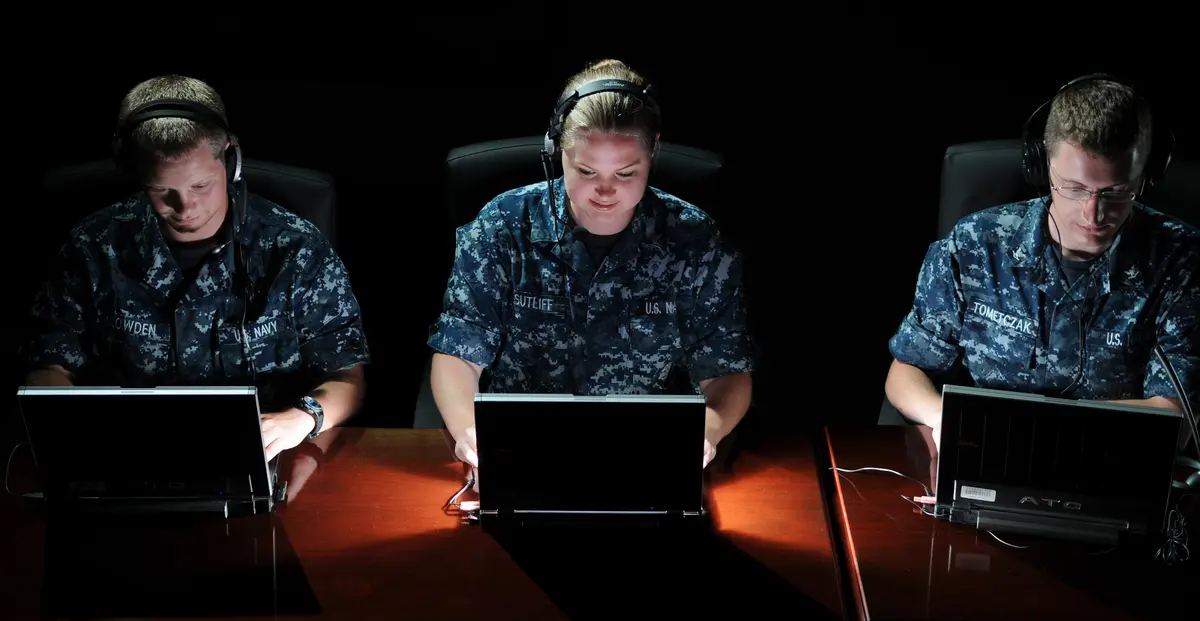
Non-tactically, it combats isolation. Sailors video-call families, stream morale events, or access telehealth reducing turnover in a force where 150+ specialties demand tech-savvy recruits. The amphibious ship USS Wasp used it for newborn dedications at sea, blending humanity with ops. In exercises, 5G enables ship-to-ship swarming for unmanned vessels, simulating fleet-on-fleet battles with real-time feeds.
| Application | Tactical Use | Non-Tactical Use | Speed Requirement | Example Benefit |
|---|---|---|---|---|
| Data Transfer | F-35 mission files, drone telemetry | Maintenance logs upload | 500 Mbps+ | 80% faster updates vs. legacy SATCOM |
| Remote Scans | Annual cyber audits from shore | N/A | 300 Mbps | Global compliance without port calls |
| Collaboration | AI-driven intel sharing | Video calls home | 100-1 Gbps | 75% morale boost, per Navy surveys |
| Training | VR simulations | Online certs | 200 Mbps+ | Reduced shore training costs by 40% |
What is Cybersecurity’s Role in the US Navy?
Cybersecurity’s role in the US Navy is foundational: it’s mission readiness incarnate. RADML Tracy Hines, Director of Navy Cyber Security Division, equates cyber prep with warfighting capability, shifting from compliance checklists to predictive defenses via AI and zero-trust models. The Navy’s Cyber Security Division (OPNAV N9A6) oversees this, integrating protections into acquisition from day one ensuring new ships like the Constellation-class frigate ship with hardened networks.
Offensively, it disrupts foes; defensively, it shields assets. The 10th Fleet/Fleet Cyber Command orchestrates this, blending human intel with tools like Microsoft Defender for endpoint security. In 2024, Flank Speed hit zero-trust milestones early, automating threat hunting across 560,000 endpoints. Challenges persist legacy gear and complacency plague readiness, per the 2019 Cybersecurity Readiness Review but innovations like automated vulnerability scans counter them.
Ultimately, cybersecurity ensures the Navy’s electromagnetic edge, from denying adversaries domain access to safeguarding unmanned swarms.
Does the US Military Have Cybersecurity?
Yes, the US military has robust cybersecurity, centralized under U.S. Cyber Command (USCYBERCOM), which synchronizes operations across services. Established in 2010, it defends DoD networks and conducts full-spectrum ops, with the Navy contributing via the 10th Fleet. Army Cyber Command and Air Force’s 16th Air Force mirror this, staffing 6,000+ personnel in 133 teams. The NDAA for FY2017 elevated USCYBERCOM to combatant command status, mandating persistent defense.
Does the Navy Have Cyber Security Jobs?
Absolutely does the navy have cyber security jobs? Roles abound, from enlisted Cyber Warfare Technicians (CWTs) manning defenses at NIOC Fort Meade to officers as Maritime Cyber Warfare Officers (MCWOs) leading ops. CWTs, post-23-week “A” School in Pensacola, handle forensics and network ops worldwide, earning TS/SCI clearances. The new MCWO designator, per FY2023 NDAA, carves dedicated paths to flag rank, with 2025 task forces building talent pipelines. NAVSEA adds civilian gigs in IT/cyber, blending military and contractor expertise.
Top Challenges in Cybersecurity High Speed Internet US Navy Operations
The crux: top challenges in cybersecurity high speed internet US Navy operations. First, expanded attack surfaces commercial LEOs like Starlink introduce unvetted vectors, as seen in the USS Manchester’s rogue Wi-Fi fiasco, risking detection in ops zones. Second, legacy integration: 70% of ships run outdated systems, per readiness reviews, vulnerable to supply-chain exploits. Third, talent gaps shortages of cyber pros hinder scaling zero-trust, exacerbated by retention woes.
Quantum threats loom, potentially cracking encryptions, while AI-driven attacks automate phishing at scale. Emissions control conflicts with connectivity; ships must toggle links during stealth modes, balancing speed with silence. Budgets strain too SEA2’s rollout demands $35M+ in upgrades, competing with hulls in the water.
Mitigations include AI analytics for anomaly detection and partnerships with Microsoft for cloud hardening. Yet, cultural shifts from complacency to proactive ethos are vital, mirroring private-sector agility.
Insights from Global Cyber Landscapes: Cyber Intelligence Pakistan and Cybersecurity Pakistan
To contextualize U.S. challenges, consider cyber intelligence Pakistan and cybersecurity Pakistan. Pakistan’s National Centre for Cyber Security (NCCS), launched in 2018, mirrors Navy R&D labs, focusing on forensics and IoT defenses amid 5.3M attacks in Q1-Q3 2025. Kaspersky blocked 16M threats there, with banking malware up 59% echoing Navy supply-chain fears. ISI-linked APTs, like APT 36, spoof GPS and deface sites, tactics the Navy counters via 67th Cyberspace Wing’s ISR.
Pakistan’s framework, via PECA 2016, lags in data protection, ranking low on global indices lessons for Navy policy gaps. Collaborations with China/Turkey for threat intel parallel Navy-industry ties, underscoring shared needs in emerging tech like AI warfare.
Specialized Units and Tools: Cyber Security Wing and Cyber Security Ranger
The cyber security wing in the U.S. context refers to Air Force-led units like the 67th and 688th Cyberspace Wings, but Navy analogs include Fleet Cyber Command’s ops groups. These deliver offensive/defensive capabilities, with the 688th winning 2024 Cyber Range CTFs training Navy teams emulate via SANS ranges.
Cyber security ranger evokes elite training, akin to Cyber Struggle’s Ranger Certification blending special forces rigor with cyber drills for incident response. Navy CWTs undergo similar, mastering CLI defenses in simulated breaches. High on cyber? It’s the adrenaline of outsmarting AI foes, as in Pakistan’s CTI Summit, where experts decode DNS threats.
Conclusion: Navigating the Cyber Seas Ahead
The top challenges in cybersecurity high speed internet US Navy operations attack surfaces, legacies, talent demand bold action: automate compliance, invest in AI sentinels, and foster a cyber-first culture. As SEA2 scales, it promises a connected force multiplier, but only if shielded by unyielding defenses. For aspiring cyber sailors or industry allies, the call is clear: join the fray. Explore Navy careers at navy.com or partner via NAVWAR. Secure the spectrum; secure the seas.
FAQ
How is high-speed internet used in the Navy?
High-speed internet powers tactical data transfers like F-35 updates and remote scans, while boosting morale through family video calls and events like Super Bowl streams.
What is cybersecurity’s role in the US Navy?
It ensures mission readiness by defending networks, disrupting adversaries, and integrating zero-trust into ops, led by OPNAV N9A6.
Does the navy have cyber security jobs?
Yes, roles like CWTs and MCWOs offer hands-on ops, with paths to flag rank and global assignments.
Does the US military have cybersecurity?
Affirmative USCYBERCOM orchestrates it, with service-specific commands like the Navy’s 10th Fleet defending DoD networks.
What internet does the military use?
A secure hybrid: DISN (NIPRNet/SIPRNet) fused with commercial LEOs like Starlink under SEA2 for resilient, encrypted access.
How fast is Verizon internet?
Fios hits 300 Mbps-2 Gbps; 5G Home 300-1,000 Mbps vital for Navy’s CCaaT tactical edges.