 11
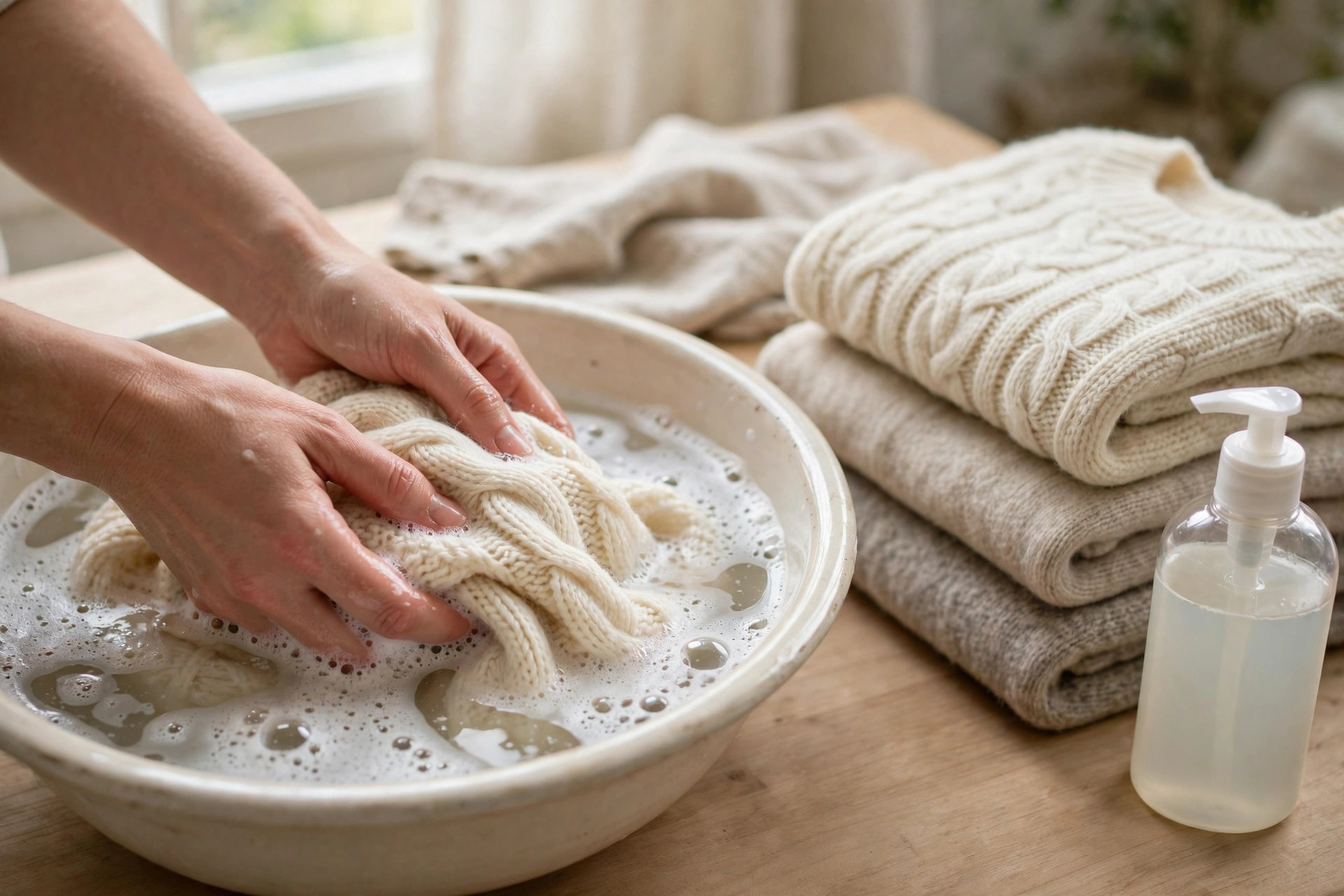
The safe way to wash a wool sweater is to hand wash it in cool water (30°C / 86°F or colder) with a small amount of wool detergent, soak for 10 to 15 minutes without rubbing or wringing, rinse in water at the same temperature, press the water out in a towel, and dry it flat. Wool shrinks from heat and rubbing, not from water alone — so keep both away and your sweater keeps its size. Machine washing is only safe if the care label says “machine washable” or “superwash,” and only on the wool or delicate cycle with cold water, a mesh bag, and a slow spin. Never put wool in the dryer. This guide walks you through all of it: the 7 hand-wash steps, the exact machine settings, how to dry it, and how to rescue a sweater that already shrank.
Wool fibers are made of keratin — the same protein as your hair — and each fiber is covered in tiny scales. When heat, moisture, and rubbing combine, those scales lift, catch on each other, and lock together. The knit contracts, thickens, and stiffens. That process is called felting, and once it happens, it is mostly permanent. The good news: felting needs all three triggers at once, so removing just one keeps your sweater safe. That is why cool water and a gentle touch work — and why the dryer, which adds heat and tumbling together, is the worst place for wool.
You do not need much — most of it is already in your home:
A clean basin, sink, or tub. Big enough for the sweater to float freely without being crammed in. A kitchen sink works for most sweaters; a bathtub is better for a heavy, chunky knit.
Cool to lukewarm water. No warmer than 30°C (86°F). It should feel neutral, not warm, on your wrist.
A wool detergent. Look for one labeled for wool, silk, or delicates — pH-neutral and enzyme-free. Brands like Woolite, Eucalan, or The Laundress Wool & Cashmere all work, and a few drops of mild baby shampoo will do in a pinch. Never use a standard “bio” detergent: its protease enzymes are made to break down protein, and wool is protein. Skip bleach entirely and skip fabric softener too, since it coats the fibers and flattens them.
Two clean, dry towels. One for rolling the water out, one (or a mesh drying rack) for the flat dry.
Hand washing is the safest method for any wool sweater, and it takes about fifteen minutes of actual work. The rest is just waiting while it soaks and dries.
Before the sweater touches water, check the label sewn into the seam. A tub with a hand in it means hand wash only. A tub with a number sets the maximum water temperature. A tub with an X through it means do not wash at all — take it to a dry cleaner instead. If the label says “dry clean only” and you are not confident, respect it. When in doubt, or when there is no label, hand washing is always the safest choice.
Fill your clean basin or sink with cool water — never above 30°C (86°F) — and add a small amount of wool detergent. About a capful is enough for one sweater. Swish the water to dissolve the detergent fully before the sweater goes in.
Turn the sweater inside out to protect the outer face from friction and pilling. Lower it into the water and press it gently under the surface a few times so it soaks through. Do not scrub, rub, or twist — just let the water and detergent do the work.
Leave the sweater alone for 10 to 15 minutes. That is enough time for the detergent to lift dirt and body oils. Soaking longer does not clean it better. If one spot is dirty, press it very gently between your fingertips — never rub wool against itself.
Drain the soapy water and refill the basin with clean water at the same temperature. This part matters more than most guides admit: a sudden jump from warm to cold water can trigger felting on its own, so keep the rinse water the same cool temperature as the wash water. Press the sweater gently to push the soap out, then drain and refill again until the water runs clear — usually two rinses. A splash of white vinegar in the final rinse helps remove detergent residue, but use it sparingly.
Here is where most people ruin a good sweater: wringing. Never twist or wring wet wool — it stretches the fibers permanently and can felt them. Instead, lift the sweater out supported in both hands, because wet wool is heavy and stretches under its own weight. Press it gently against the side of the basin to push water out. Then lay it flat on a clean, dry towel, roll the towel up like a sleeping bag with the sweater inside, and press down on the roll to squeeze out more moisture. Unroll it, and if the sweater is still very wet, repeat with a second dry towel.
Lay the sweater on a fresh dry towel or a mesh drying rack, and gently reshape it to its original size — smooth the sleeves to the right length, straighten the hem, and even out the shoulders. Keep it away from radiators, direct sunlight, and any heat source. Now leave it alone. Drying takes time, and that is normal.
Yes — but only under strict conditions. If the care label says “machine washable” or “superwash,” the machine is fine. Superwash wool has been treated with a coating that stops the fiber scales from locking together, so it tolerates a machine cycle. Untreated wool should never go in the machine, even on a wool cycle.
When machine washing is allowed, use exactly these settings:
| Setting | What to choose | Why it matters |
|---|---|---|
| Cycle | Wool, delicate, or hand-wash cycle | Short, gentle action with minimal agitation |
| Water temperature | Cold, 30°C (86°F) maximum | Heat is the main felting trigger |
| Spin speed | 600 RPM or lower | Fast spinning stretches and felts wool |
| Detergent | Liquid wool or delicates detergent | pH-neutral, enzyme-free, no bleach |
| Protection | Inside out, in a mesh laundry bag | Cuts friction and stops stretching |
| Load size | Two or three sweaters at most | They need room to move freely |
Take the sweater out the moment the cycle ends — leaving it bunched up in the drum creases it — and dry it flat, exactly as in step 7 above. If your machine has no wool cycle, the hand-wash cycle is the next best option.
Drying is half the job, and rushing it is how a clean sweater loses its shape. Never hang a wet wool sweater — gravity pulls the water down and stretches the knit out of shape, sometimes permanently. Never use the tumble dryer, not even on low: heat plus tumbling is the exact recipe for felting.
Always dry flat. Lay the reshaped sweater on a dry towel or a mesh rack in a room with good airflow, away from direct sun and radiators. Flip it over after about 6 to 8 hours so the underside dries too, and swap in a fresh dry towel underneath if the first one gets damp. Total drying time runs 12 to 36 hours depending on how thick the knit is — a fine merino layer dries overnight, while a heavy cable-knit can take a day and a half. That is normal. Do not speed it up with a hair dryer or a heater; you will felt or scorch the fibers.
Once it is fully dry, fold the sweater for storage — never hang it. Hanging stretches wool out of shape over weeks, even when it is dry. Folded, in a drawer or on a shelf with a cedar block or lavender sachet to keep moths away, it will hold its shape until next winter.
If the damage is already done, there is one rescue worth trying — but be honest with yourself first. This method works when a sweater has shrunk a little, or tightened up without fully felting. If the knit has gone thick, stiff, and matted, it has felted, and felting is permanent. Still, it costs almost nothing to try.
Fill a basin with lukewarm water and stir in a generous amount of plain hair conditioner or baby shampoo — roughly one tablespoon per liter of water. Conditioner relaxes the keratin fibers, which is why it works: it is made for hair, and wool is the same protein. Soak the sweater for 15 to 30 minutes. Then, without rinsing, gently stretch it back toward its original size while it is still in the water — pull the sleeves longer, widen the body, smooth the hem. Lift it out, press the water out in a towel (no wringing), and lay it flat to dry, reshaping it every few hours as it dries.
Expect partial recovery, not a miracle. A sweater that shrank one size might come back most of the way; one that shrank three sizes will not.
Using hot water. The single biggest cause of shrinkage. If the water feels warm on your wrist, it is too hot. Keep it cool.
Wringing it out. Twisting wet wool stretches and felts the fibers. Press it in a towel instead — every time.
Using regular detergent. Standard “bio” detergents contain protease enzymes that digest protein, and wool is protein. Use a wool-specific wash.
Hanging it to dry. A wet sweater stretches under its own weight. Dry flat, always.
Putting it in the dryer. Even on low, heat plus tumbling felts wool. The dryer is the one place a wool sweater should never go.
Washing it too often. Wool is naturally odor-resistant thanks to the lanolin in its fibers. Most sweaters only need washing after 4 to 6 wears, or at the end of the season. Airing it out overnight after each wear does most of the work.
Skipping the rinse temperature rule. Rinsing in water much colder or hotter than the wash water can shock the fibers into felting. Keep wash and rinse at the same cool temperature.
Just a light smell, no stains: Do not wash it at all. Hang the sweater in fresh air overnight, or outside in the shade for a few hours. Wool sheds odors on its own, and airing is usually enough.
One small stain: Spot-clean instead of washing the whole sweater. Dab the stain with cool water and a drop of wool detergent, press gently with a clean cloth, and rinse the spot the same way. Let it dry flat.
Cashmere: Wash it the same way as wool — cool water, gentle detergent, flat dry — but be even gentler, and wash it at most twice a season. Cashmere fibers are finer and felt faster than regular wool.
A chunky or heavy knit: Use the bathtub instead of a sink so the sweater floats freely, support it with both hands when lifting it out, and expect up to 36 hours to dry flat. Never hang it, even for a minute.
End of the season: Wash the sweater once before you store it — body oils and food stains attract moths over summer. Make sure it is completely dry, fold it (do not hang it), and store it with a cedar block or lavender sachet.
Yes, but only if the care label says “machine washable” or “superwash.” Use the wool or delicate cycle with cold water (30°C / 86°F maximum), a liquid wool detergent, a slow spin of 600 RPM or less, and a mesh laundry bag with the sweater turned inside out. Take it out as soon as the cycle ends and dry it flat.
Use a pH-neutral, enzyme-free detergent made for wool or delicates — brands like Woolite, Eucalan, or The Laundress Wool & Cashmere. A few drops of mild baby shampoo work in a pinch. Avoid standard “bio” detergents (their enzymes break down protein), never use bleach, and skip fabric softener.
Dry it flat, always. Roll it in a dry towel to press out the water, then lay it on a fresh towel or mesh rack, reshaped to its original size, away from heat and direct sun. Flip it after 6 to 8 hours. It takes 12 to 36 hours depending on thickness. Never hang a wet wool sweater and never use the tumble dryer.
Soak it for 15 to 30 minutes in lukewarm water mixed with hair conditioner or baby shampoo (about one tablespoon per liter). Gently stretch it back to size while it is still wet, press the water out in a towel, and dry it flat, reshaping as it dries. This works for light shrinkage; a fully felted sweater cannot be fixed.
Far less than you think. Wool resists odor naturally, so most sweaters only need washing after 4 to 6 wears, or when visibly soiled — plus once at the end of the season before storage. Between washes, air it out overnight.
Yes. Cashmere is washed exactly like wool: cool water, gentle wool detergent, no wringing, dry flat. Be even gentler with cashmere because its fibers are finer and felt faster, and wash it at most twice a season.