




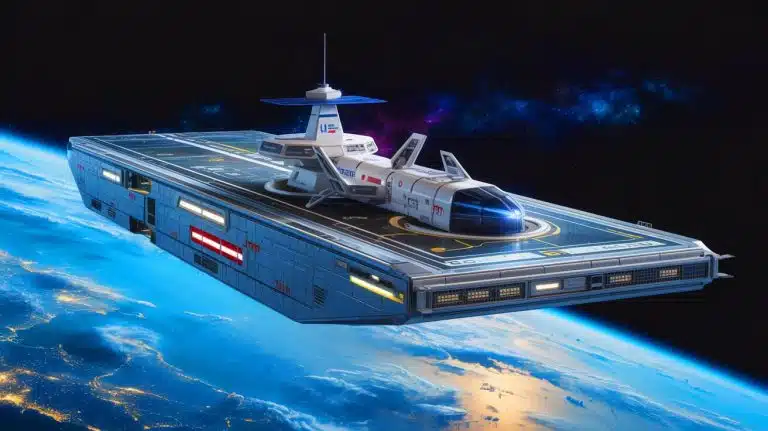
The domain of space is no longer a peaceful frontier. With rising tensions from advanced anti-satellite weapons developed by near-peer adversaries, the United States has pivoted toward proactive defense in orbit. Enter the space force orbital warship carrier concept—a term now circulating widely in defense discussions. While it evokes images of massive sci-fi battleships, the reality ties directly to a tangible U.S. Space Force initiative: the Gravitics Orbital Carrier project.
This program, backed by up to $60 million in funding, aims to create a pre-positioned platform in space that functions like a mobile launch pad. It addresses a critical vulnerability: the delay in traditional rocket launches when satellites fail or threats emerge. In an era where seconds matter for maintaining communication, navigation, and intelligence, the space force orbital aircraft carrier could redefine how America projects power beyond Earth. Understanding this development is essential because it signals a shift from passive satellite constellations to agile, tactically responsive space operations.
The U.S. Space Force: From Support Role to Orbital Warfare Leader
Established in December 2019 as the newest branch of the U.S. military, the Space Force focuses on organizing, training, and equipping forces for space superiority. Its guardians over 8,600 strong—manage everything from GPS and missile warning to protecting vital assets against jamming, lasers, and kinetic attacks.
Space has become contested. China and Russia have tested co-orbital inspectors, direct-ascent missiles, and electronic warfare tools capable of blinding or destroying satellites. In response, the Space Force created Mission Delta 9 for orbital warfare, training guardians to maneuver assets offensively and defensively. The us space force developing orbital carrier to rapidly deploy satellites in space fits this doctrine perfectly. Instead of waiting weeks or months for a ground launch after an asset is compromised, a pre-positioned platform could release replacement vehicles within hours or days.
This capability matters deeply. Modern warfare relies on space-enabled precision strikes, real-time intelligence, and resilient networks. Losing even a handful of satellites could blind commanders or disrupt supply chains. The space force orbital warfare strategy emphasizes speed and survivability, and the orbital carrier project accelerates that vision.
Gravitics Orbital Carrier: The Project Taking Shape
In March 2025, SpaceWERX the Space Force’s innovation arm selected Seattle-based Gravitics for a Strategic Funding Increase (STRATFI) contract worth up to $60 million. The goal: demonstrate and eventually fly the gravitics orbital carrier, officially named the Orbital Carrier.
Gravitics CEO Colin Doughan described it as “a game-changer, acting as a pre-positioned launch pad in space. It bypasses traditional launch constraints, enabling space vehicle operators to rapidly select a deployment orbit on-demand.” Unlike rockets that must fight gravity from the ground, this platform would sit in orbit, ready to release maneuverable space vehicles on command.
The orbital aircraft carrier development spaceforce gravitics leverages the company’s expertise in large modular space structures. Future versions could offer 60 cubic meters of internal volume and support 5,000–10,000 kg of cargo. A smaller prototype is targeted for an initial demonstration as early as 2026, with operational flights potentially following in 2027.
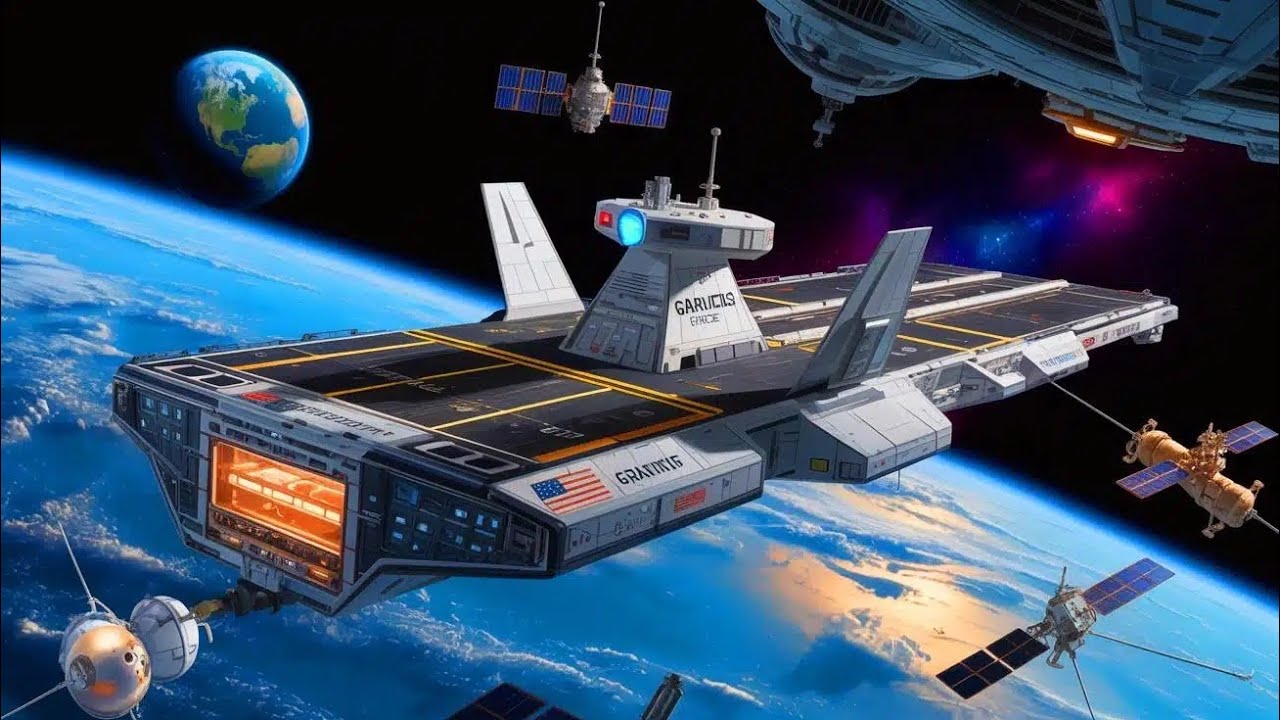
The orbital aircraft carrier satellite deployment process works like this: The carrier pre-positions multiple smaller spacecraft in a strategic orbit. When a threat appears say, a laser dazzling a reconnaissance satellite or jamming disrupting GPS—the platform deploys a replacement or countermeasure vehicle directly into the needed path. This eliminates weather delays, range restrictions, and the high cost of full rocket launches from Earth.
No public details exist on the exact space force orbital aircraft carrier location, as operational orbits remain classified for security. Likely candidates include low Earth orbit for rapid response or geosynchronous slots for persistent coverage.
How the Orbital Carrier Fits Into Space Force Orbital Warfare
The space force orbital warship carrier concept directly supports “tactically responsive space.” Space Force leaders have stressed that future conflicts will require surging capabilities on short notice. Russia and China continue advancing counterspace systems, making pre-positioned assets a deterrent and a force multiplier.
By storing and deploying satellites from orbit, the carrier reduces reliance on vulnerable ground infrastructure. It also enables new tactics: rapid constellation replenishment, on-orbit servicing, or even positioning interceptors if needed. While not armed like a traditional warship, its role in space force orbital warfare is clear maintaining superiority through agility rather than brute force.
Timeline of Orbital Carrier Development
To track progress, here’s a clear overview of milestones based on official announcements and reporting:
| Milestone | Date | Details |
|---|---|---|
| Contract Award | March 26, 2025 | Up to $60M STRATFI funding via SpaceWERX for demonstration and flight |
| Prototype Design Phase | 2025 | Detailed engineering begins; smaller-scale version prioritized |
| Prototype Unveiling | November 2025 | Initial hardware revealed at industry events |
| First Orbital Demonstration | Targeted for 2026 | Smaller vehicle launch to prove deployment capabilities |
| Full-Scale Operational Flight | NET 2027 | Larger carrier with expanded payload capacity expected |
| Annual Launch Cadence | 2028 onward | Goal of at least one launch per year for sustained operations |
Challenges: Why a True “Warship” Remains Future Tech
While exciting, the space force aircraft carrier project faces significant hurdles. Launching a large structure into orbit requires massive rockets and precise assembly. Radiation, micrometeorites, and thermal extremes demand robust shielding. Refueling or resupplying the carrier would need advanced in-space logistics still under development.
Unlike naval carriers with thousands of sailors, this platform is expected to operate uncrewed or with minimal automation initially. Energy demands for propulsion and deployment systems are enormous current ion thrusters or chemical rockets may suffice for small maneuvers but scaling up remains complex.
Critics note that a single large platform could become a high-value target, vulnerable to the same threats it aims to counter. Distributed architectures (many smaller nodes) may prove more resilient long-term. Still, the orbital aircraft carrier development spaceforce gravitics represents an important stepping stone toward sustainable in-orbit infrastructure.
Naval Aircraft Carrier vs. Orbital Carrier: A Side-by-Side Comparison
The analogy to traditional carriers helps illustrate the vision. Here’s how they align and diverge:
| Feature | Naval Aircraft Carrier | Orbital Carrier (Gravitics Concept) |
|---|---|---|
| Operating Environment | Surface of the ocean | Earth orbit (vacuum, microgravity) |
| Primary Mission | Launch, recover, and support fighter jets | Pre-position and rapidly deploy satellites/vehicles |
| Typical Crew Size | 4,000–5,000 personnel | Likely uncrewed or minimal automation |
| Deployment Speed | Aircraft in minutes | Satellites/vehicles in hours (on-demand orbit selection) |
| Strategic Advantage | Power projection across seas | Responsive space operations against orbital threats |
| Vulnerability | To submarines, missiles | To ASAT weapons, jamming, or kinetic interceptors |
| Analogy in Action | Assets ready near conflict zones | Assets pre-positioned for immediate orbital response |
Addressing Common Questions About the Project and Space Operations
Is the orbital aircraft carrier real?
Yes, in the form of the Gravitics Orbital Carrier. It is not a fully operational warship yet, but the project is actively funded and moving toward a 2026 demonstration. Official Space Force and Gravitics documentation confirm its development for satellite deployment and rapid response.
Why can’t an F-22 land on an aircraft carrier?
The F-22 Raptor lacks the reinforced landing gear, tailhook, and structural modifications needed for arrested landings on a moving deck. Its high-speed design prioritizes air superiority, not carrier operations naval variants like the F/A-18 handle those stresses instead.
How do 5000 people eat, sleep, and work in the middle of the ocean?
Modern supercarriers like the Nimitz or Ford class operate like floating cities. Crews rotate through 24-hour watches, with galleys serving thousands of meals daily using industrial kitchens. Berthing areas, gyms, medical facilities, and even email/internet systems support long deployments. Logistics ships resupply every few weeks to sustain operations far from port.
Does the Space Force do any fighting?
Not in the traditional ground-combat sense. Its mission centers on space domain awareness, satellite operations, and enabling joint forces. However, guardians now train for orbital warfare maneuvers, including offensive and defensive actions to protect or deny space capabilities. The Orbital Carrier project strengthens this warfighting role without direct kinetic engagement.
When might the first Orbital Carrier launch?
A smaller demonstration vehicle targets 2026, with full-scale operations possibly in 2027. Delays are possible given the complexity of space hardware.
What advantages does rapid satellite deployment offer?
It allows replacement of damaged assets during conflict, maintains constellation integrity, and supports dynamic mission adjustments—critical when adversaries can disrupt satellites in minutes.
Could this technology lead to crewed space warships someday?
Potentially, but current designs focus on uncrewed logistics and deployment. Advances in life support, propulsion, and international treaties would be required for crewed versions.
Why This Development Matters for National Security
The space force orbital warship carrier or more precisely, the Gravitics Orbital Carrier marks a pivotal investment in America’s ability to maintain advantage in orbit. By enabling the us space force developing orbital carrier to rapidly deploy satellites in space, it counters growing threats and ensures resilient support for troops, ships, and aircraft worldwide.
As development progresses, expect more details on testing and integration. For now, the project underscores a simple truth: the next battlefield may begin 200 miles above Earth, and preparation is already underway.
Stay informed by following official Space Force updates or visiting Gravitics’ site for the latest on orbital aircraft carrier satellite deployment advancements. The future of orbital operations is unfolding-understanding it today helps secure it tomorrow.