





In the fast-evolving world of software as a service (SaaS), launching a product isn’t enough it’s how you bring it to market that determines long-term success. A robust gtm strategy for saas acts as your roadmap, aligning product development, marketing, sales, and customer success to capture market share, drive recurring revenue, and outpace competitors. With the global SaaS market projected to exceed $300 billion by 2025, according to recent industry reports, getting your go-to-market (GTM) right can mean the difference between rapid scaling and early stagnation.
Why does this matter now? Economic pressures like rising customer acquisition costs (CAC) averaging $550 for B2B SaaS and lengthening sales cycles demand precision. A well-executed gtm strategy for saas reduces risks, optimizes resources, and fosters predictable growth. In this guide, we’ll break down the essentials, from foundational concepts to actionable frameworks, drawing on proven tactics from leaders like Slack and HubSpot. Whether you’re a startup founder or scaling team lead, you’ll walk away with a blueprint to refine your approach.
What is SaaS GTM Strategy?
At its core, a SaaS GTM strategy is a comprehensive plan outlining how your company will introduce, position, and sell its software to target customers while achieving a competitive edge. Unlike traditional software sales, SaaS thrives on recurring revenue models, making customer retention and lifetime value (LTV) central to the equation. This strategy encompasses everything from market entry tactics to post-launch optimization, ensuring your product doesn’t just launch but lands with impact.
For B2B SaaS, where decisions involve multiple stakeholders and cycles can stretch 6-12 months, a SaaS GTM strategy emphasizes alignment across teams. It addresses key questions: Who are your ideal customers? How will you reach them? What value do you deliver, and how do you measure success? Research from Gartner highlights that companies with unified GTM plans see 20-30% higher revenue growth compared to siloed efforts.
In practice, this means blending inbound content, outbound sales, and product-led growth (PLG) elements. For instance, a SaaS GTM strategy might start with freemium trials to lower barriers, followed by targeted email nurturing to convert free users to paid. The goal? Not just acquisition, but building a flywheel where satisfied customers fuel expansion through upsells and referrals.
Deep insight: In B2C SaaS, the focus shifts to viral loops and self-serve onboarding, but B2B demands personalized demos and ROI proofs. Neglecting this nuance leads to 40% of launches failing to meet targets, per McKinsey data. By prioritizing customer pain points like inefficient workflows in CRM tools your SaaS GTM strategy transforms from a checklist into a revenue engine.
The 3 3 2 2 2 Rule of SaaS: A Growth Benchmark
Growth in SaaS isn’t linear; it’s explosive yet sustainable. Enter the 3 3 2 2 2 rule of SaaS, a benchmark popularized by investors like Bessemer Venture Partners and SaaStr. Starting from a baseline of $1-2 million in annual recurring revenue (ARR), this rule prescribes tripling revenue in the first two years (3x, 3x), then doubling it for the next three (2x, 2x, 2x). The result? Scaling to $100 million ARR in 5-6 years, positioning your company for unicorn status.
Why does the 3 3 2 2 2 rule of SaaS work? It balances aggressive expansion with operational maturity. Early tripling leverages product-market fit (PMF) through viral acquisition and low CAC, while later doubling emphasizes efficiency via churn reduction and net revenue retention (NRR) above 120%. For example, from $1M ARR, Year 1 hits $3M, Year 2 $9M, then $18M, $36M, and $72M by Year 5.
| Year | Growth Multiple | ARR Milestone (from $1M Start) | Key Focus Areas |
|---|---|---|---|
| 1 | 3x | $3M | Validate PMF, optimize PLG |
| 2 | 3x | $9M | Scale marketing, reduce CAC |
| 3 | 2x | $18M | Enterprise sales, integrations |
| 4 | 2x | $36M | Retention plays, upsell motions |
| 5 | 2x | $72M | Global expansion, efficiency |
The 10x Rule for SaaS: Pricing and Value Creation
Pricing isn’t arbitrary in SaaS it’s a science. The 10x rule for SaaS dictates that your product must deliver at least 10 times the value of its price to justify adoption and overcome inertia. Coined in value-based pricing discussions, this principle ensures customers see massive ROI, turning skeptics into advocates.
Apply it like this: If your tool saves a sales team 20 hours weekly at $50/month ($600/year), it must unlock $6,000+ in annual value (e.g., via 10% faster deals). Dropbox exemplified this with freemium storage that virally expanded to enterprise plans, delivering collaboration efficiencies worth far more than the cost.
Deep dive: Mispricing plagues 70% of SaaS launches, per Cobloom research. Use the 10x rule for SaaS in tiered models freemium for trials, pro for scale, enterprise for customization. Test via A/B pricing pages and customer interviews. Insight: High-value perception boosts willingness to pay by 25%, per Sixteen Ventures. Integrate this into your gtm strategy for saas by quantifying ROI in demos: “Our users recover costs in 1 month through X% productivity gains.”
What is an Example of a GTM Strategy?
Real-world wins illuminate best practices. Take Slack: Their gtm strategy for saas example blended PLG with targeted outreach. Launching in 2013, Slack offered free tiers for small teams, leveraging integrations (e.g., Google Workspace) to drive viral adoption. Content like “Why Slack?” guides educated buyers, while sales teams nurtured mid-market leads. Result? 15,000 users in two weeks, scaling to $100M ARR in 2.5 years.
Another gtm strategy for saas example: HubSpot’s inbound playbook. They created free tools (CRM) and educational content (ebooks on SEO), funneling leads into nurture sequences. Partnerships with agencies amplified reach, achieving 100,000 customers by focusing on SMB pain points like lead gen.
| Company | Core Tactic | Key Metric Achieved | Lesson for Your GTM |
|---|---|---|---|
| Slack | Freemium + Integrations | 4M daily users in Year 1 | Prioritize self-serve onboarding |
| HubSpot | Content-Led Inbound | 50% of revenue from free-to-paid | Build trust via value-first marketing |
| Zoom | Viral Loops + Reliability | 300M daily participants (2020) | Ensure product excellence for word-of-mouth |
GTM Strategy for SaaS PDF: Essential Resources
For hands-on implementation, downloadable guides are gold. A gtm strategy for saas pdf like Amplitude’s “Ultimate Guide to SaaS Go-To-Market Strategy” details market research, value props, and onboarding flows. Download it here for templates on buyer personas and KPIs.
Similarly, the SaaS go-to market strategy PDF from Cognism outlines five steps: ICP definition, channel selection, and metrics tracking. It’s ideal for B2B teams, with checklists for sales alignment.
B2B SaaS Go-to-Market Strategy Template
Tailor your plan with a B2B SaaS go-to-market strategy template. Cascade’s free version includes sections for objectives, audience segmentation, and KPIs, ensuring cross-team buy-in.
| Template Section | Key Elements | Tools/Examples |
|---|---|---|
| Market Analysis | Size, trends, competitors | SWOT matrix; Use SEMrush for sizing |
| ICP & Personas | Firmographics, pain points | 3-5 personas; HubSpot template |
| Value Prop & Pricing | 10x rule application | Tiered plans; A/B test via Optimizely |
| Channels & Tactics | PLG, inbound, ABM | Content calendar; LinkedIn ads |
| Metrics & Iteration | CAC, LTV, NRR | Dashboard in Google Analytics |
SaaS GTM Playbook: Your Execution Bible
A SaaS GTM playbook operationalizes strategy into repeatable plays. Kalungi’s B2B SaaS Playbook (T2D3 framework) guides from PMF to $10M ARR, emphasizing organic SEO and paid pilots. Access it here for checklists on outbound cadences.
Forum Ventures’ playbook covers prospecting scripts and discovery calls, proven for early-stage wins. Insight: Playbooks cut ramp time by 30%, per SaaStr, by standardizing handoffs.
GTM Strategy Framework: Building Blocks for Success
Frameworks provide structure. McKinsey’s GTM model focuses on seven growth vectors: market penetration, adjacent segments, and geography. For SaaS, adapt it with PLG layers.
Gartner’s framework stresses “who” (ICP) and “how” (channels). Slideworks’ 217-slide template here visualizes Analyze-Design-Deliver phases.
| Framework | Strengths | Best For |
|---|---|---|
| McKinsey 7 Vectors | Holistic expansion | Mature SaaS scaling globally |
| Gartner GTM | Customer-centric | B2B with complex sales |
| Ansoff Matrix | Risk-balanced growth | New product launches |
Go-to-Market Strategy Example PDF: Learn from the Pros
Visual aids accelerate learning. High Alpha’s go-to-market strategy example PDF dissects Slack’s playbook, from freemium hooks to enterprise upsells. Download here.
For McKinsey insights, their go-to-market strategy McKinsey pdf on EV launches (adaptable to SaaS) covers segmentation and digital channels. It’s a masterclass in adaptive models.
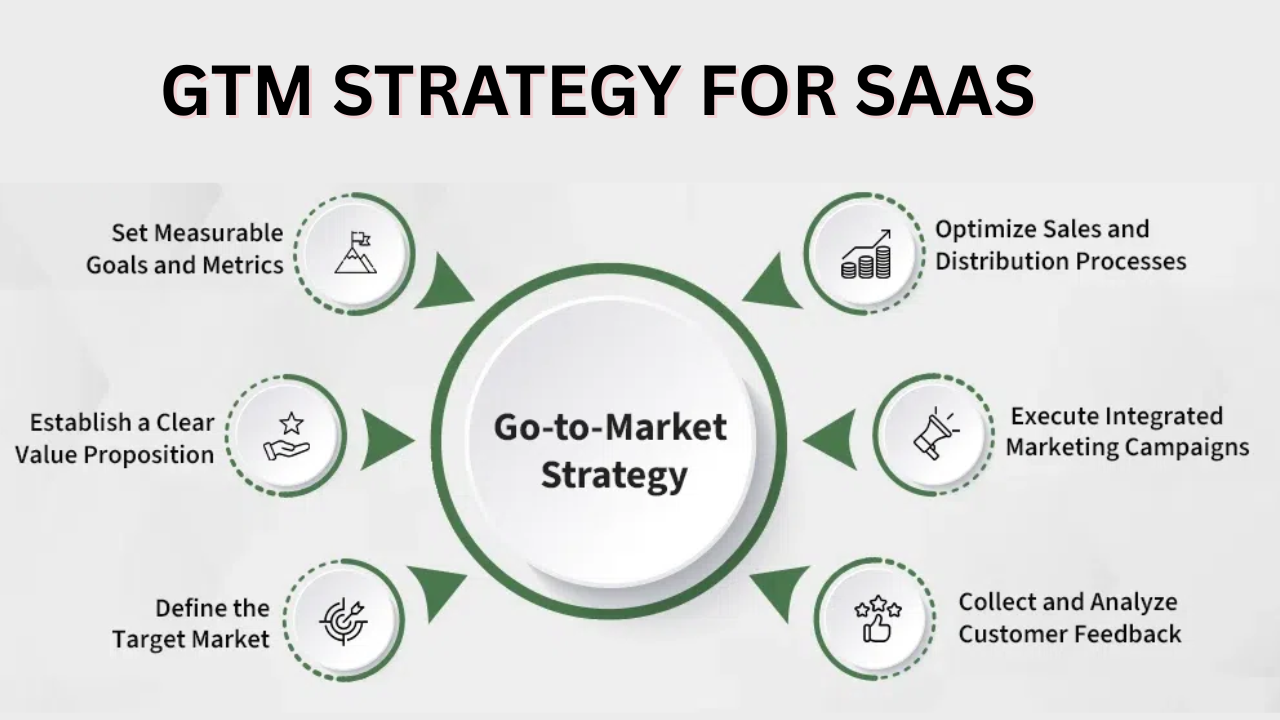
Step-by-Step Guide to Building Your GTM Strategy for SaaS
- Conduct Market Research: Analyze TAM/SAM, competitors via tools like Crunchbase. Identify gaps e.g., underserved SMBs in HR tech.
- Define ICP: Build 3-5 personas with behaviors, not just demographics. Validate via surveys.
- Craft Value Prop: Apply 10x rule; test messaging in landing pages.
- Select Channels: Mix PLG (in-app tours), inbound (blogs), and outbound (LinkedIn). Budget 40% to top performers.
- Set Pricing & Packaging: Tiered models with freemium entry. Monitor via Stripe experiments.
- Build Sales Enablement: Create playbooks for demos, objections. Train on MEDDIC framework.
- Launch & Measure: Roll out in beta; track CAC:LTV (aim 1:3+), activation rates. Iterate quarterly.
Insight: 60% of SaaS failures stem from poor execution here use A/B testing to refine.
FAQ
What is SaaS GTM strategy?
A SaaS GTM strategy is a plan to launch and scale software products, focusing on customer acquisition, retention, and revenue through aligned marketing, sales, and product efforts.
What is the 3 3 2 2 2 rule of SaaS?
The 3 3 2 2 2 rule of SaaS benchmarks growth: triple ARR in Years 1-2, double in Years 3-5, from a $1M base, to hit $72M+ sustainably.
What is the 10x rule for SaaS?
The 10x rule for SaaS ensures pricing reflects 10x customer value, like time savings or revenue gains, to drive adoption and justify premiums.
What is an example of a GTM strategy?
Slack’s gtm strategy for saas example used freemium PLG and integrations for viral growth, hitting 8M users by emphasizing seamless collaboration.
Where can I find a GTM strategy for SaaS PDF?
Try Amplitude’s gtm strategy for saas pdf for templates on personas and KPIs, or Cognism’s SaaS go-to market strategy PDF for B2B checklists.
How do I use a B2B SaaS go-to-market strategy template?
Fill Cascade’s B2B SaaS go-to-market strategy template with ICP details, channel plans, and metrics to align teams for launch.
What is a SaaS GTM playbook?
A SaaS GTM playbook like Kalungi’s T2D3 guide provides scripts, cadences, and frameworks for repeatable sales and marketing execution.
Conclusion
A winning gtm strategy for saas isn’t static it’s a living framework that evolves with data and feedback. By mastering elements like the 3 3 2 2 2 rule, 10x pricing, and hybrid models, you’ll drive NRR above 120% and scale efficiently. Start small: Audit your current approach against this guide, then pilot one change, like refining your ICP.