





In today’s competitive business environment, a well-designed business card remains a powerful networking tool. It conveys professionalism, brand identity, and key contact details in a compact, tangible format. For UK businesses, getting the UK business card size right is essential not just for aesthetics, but for practical reasons like wallet compatibility, printing quality, and international consistency.
This comprehensive guide covers everything you need to know about UK business card size requirements for high-quality printing, including exact dimensions in mm, cm, inches, and pixels. Whether you’re a startup founder, freelancer, or established company rebranding, understanding these standards ensures your cards look sharp, professional, and compliant with printer expectations.
Why UK Business Card Size Matters
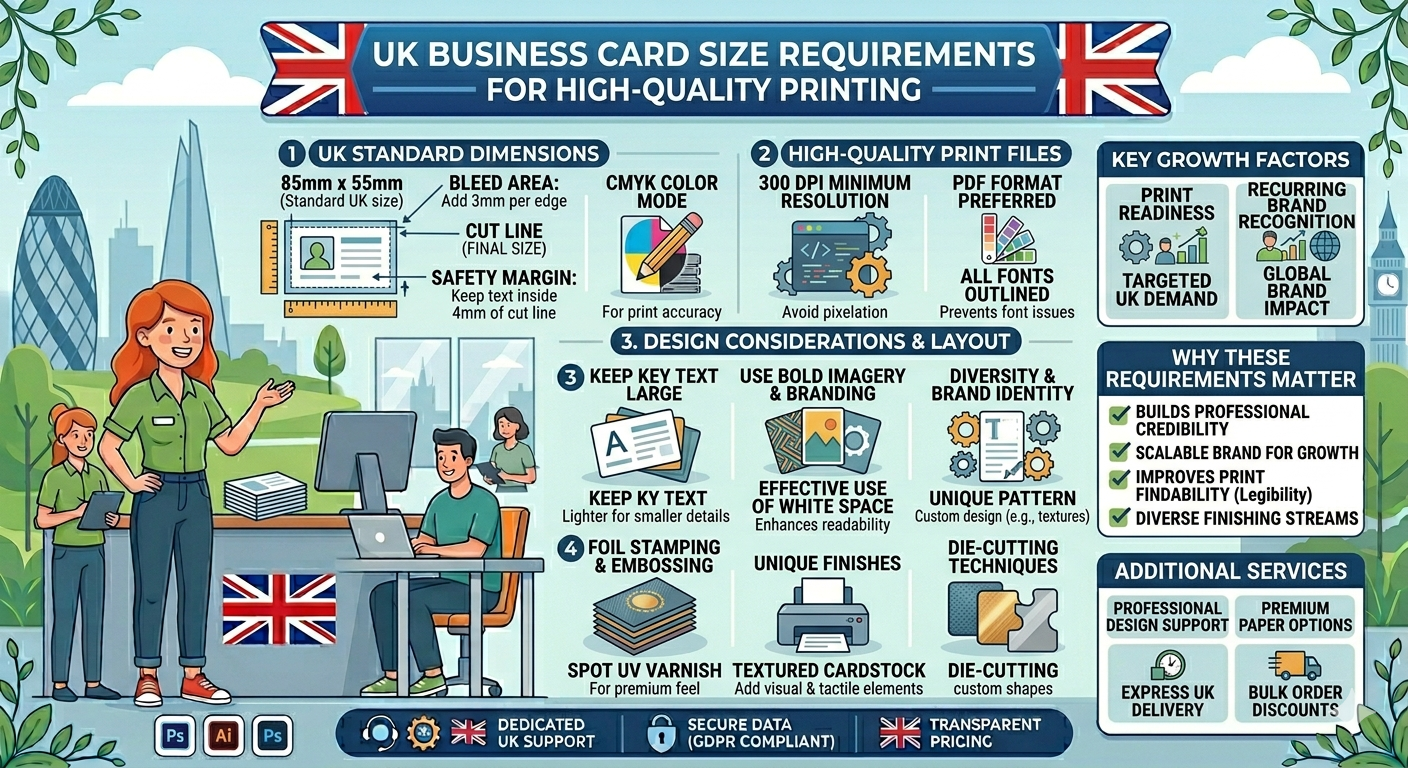
The UK follows the European/ISO-influenced standard of 85mm x 55mm, which differs from the US size. This size aligns closely with credit cards and fits neatly into standard UK and European wallets. Choosing the correct dimensions prevents costly reprinting, ensures design elements aren’t cropped, and maintains a polished appearance.
Using the wrong size can lead to alignment issues during printing, wasted materials, or cards that feel awkward to handle. High-quality printing demands precise specifications, including bleed areas and resolution, to achieve crisp text, vibrant colours, and professional finishes like spot UV or foil stamping.
Standard UK Business Card Size Dimensions
The accepted business card UK standard is:
- Millimetres (mm): 85mm width x 55mm height
- Centimetres (cm): 8.5cm x 5.5cm
- Inches: Approximately 3.35 inches x 2.17 inches
This rectangular format offers a balanced aspect ratio (roughly 1.545:1), making it versatile for both portrait and landscape orientations, though landscape is more common.
UK business card size in inches is slightly taller and narrower than the US equivalent, reflecting different wallet and cultural preferences across regions.
Comparison: UK vs US Business Card Size
| Region | Width x Height (mm) | Width x Height (inches) | Aspect Ratio | Common Use |
|---|---|---|---|---|
| UK & Europe | 85 x 55 | 3.35 x 2.17 | ~1.55 | Wallets, EU networking |
| US & Canada | 89 x 51 | 3.5 x 2.0 | 1.75 | North American markets |
| Australia | ~90 x 55 | 3.54 x 2.17 | ~1.64 | Similar to EU |
This table highlights why specifying “uk business card size” when ordering from UK printers is crucial. A US-sized card in the UK might look oversized or not fit standard holders.
Business Card Size in mm, cm, and Pixels for Printing
Printers require files set up with specific resolutions for sharp results. The industry standard is 300 DPI (dots per inch) or PPI for high-quality offset or digital printing.
Standard business card size in pixels (UK 85x55mm at 300 DPI):
- Trim size (final card): Approximately 1005 x 651 pixels (or 1004 x 650 px depending on rounding)
- With bleed (recommended): Add 3mm on all sides → ~1091 x 737 pixels or similar, depending on exact setup
Always confirm with your printer, as slight variations exist.
UK business card size pixels guidelines:
- Design at 300 DPI minimum for professional results.
- Lower resolutions (e.g., 150 DPI) may appear pixelated or blurry upon printing.
- Vector elements (logos, text) in PDF format scale perfectly without quality loss.
Business card size in mm with bleed:
- Trim: 85 x 55 mm
- Bleed: Typically +3mm per side → 91 x 61 mm total artwork size
This bleed area ensures background colours or images extend to the edge without white borders after trimming.
Key Requirements for High-Quality Printing
To achieve premium results with your uk business card size design:
- File Format: Use PDF (with embedded fonts), AI, or high-res PSD. CMYK colour mode for print (not RGB).
- Bleed and Safe Zones: Extend backgrounds 3mm beyond trim. Keep critical text and logos at least 3-5mm inside the trim edge.
- Resolution: 300 DPI at final size. Higher (up to 400 DPI) for fine details, but rarely necessary.
- Margins and Alignment: Account for slight cutting tolerances (±1mm).
- Paper Stock: 300-400gsm uncoated or silk for a premium feel. Thicker stocks convey quality.
- Finishes: Matte lamination, gloss, spot UV, foil, embossing, or rounded corners enhance perceived value.
Pro Tip: Many UK printers like Moo, Vistaprint UK, or local services provide free templates sized exactly to 85 x 55 mm with bleed guides.
Design Best Practices for UK Business Cards
Effective business cards balance information with visual appeal. With limited space on the standard business card size in cm (8.5 x 5.5), prioritize:
- Clear hierarchy: Logo, name, title, contact details.
- Readable fonts (minimum 7-8pt for body text).
- High-contrast colours that align with your brand.
- QR code linking to your website, LinkedIn, or digital portfolio.
- Back side for additional info, testimonials, or a call-to-action.
Consider orientation. Landscape suits most, but portrait can stand out in stacks. For creative industries, explore square (55x55mm) or mini cards, but stick to standard uk business card size for maximum compatibility.
Common Mistakes to Avoid
- Ignoring bleed → Edges appear cut off.
- Using web-resolution images (72 DPI) → Blurry prints.
- Overcrowding information → Cluttered, unprofessional look.
- Mixing units in design software → Scaling errors.
- Forgetting UK-specific size when ordering locally → Incompatible cards.
UK Business Card Size vs Other Variants
While 85x55mm dominates, alternatives exist:
- Square: 55x55mm – Modern and memorable.
- Mini: Narrower options for minimalists.
- Folded: Double or tri-fold for more content.
- Oversized: For impact, though less wallet-friendly.
For international work, consider dual-sided designs or separate runs for UK/EU and US markets.
How to Prepare Your Files for Professional Printing
- Set document size to 91 x 61 mm (with bleed) at 300 DPI.
- Use CMYK colour profile.
- Export as PDF/X-1a or high-quality PDF.
- Include crop marks and bleed.
- Proof carefully on screen and request physical proofs if ordering large quantities.
Most printers offer online previews and templates tailored to standard business card size in pixels and physical dimensions.
Cost and Quantity Considerations
UK printing costs vary by quantity, stock, and finishes. Economies of scale kick in at 250-500+ cards. Digital printing suits small runs with fast turnaround; offset excels for larger volumes with consistent colour.
FAQ: UK Business Card Size Requirements
What is the standard UK business card size?
The standard is 85mm x 55mm (8.5cm x 5.5cm or approx. 3.35 x 2.17 inches).
What is the UK business card size in pixels for printing?
At 300 DPI, approximately 1005 x 651 pixels for the trim area. Include bleed for the full design file.
How does UK business card size compare to US?
UK cards are 85x55mm (narrower and taller) versus US 89x51mm (wider and shorter). Always specify your market.
Do I need to add bleed for high-quality printing?
Yes. Add 3mm bleed on all sides to prevent white edges and ensure full coverage.
What resolution should I use for business card design?
300 DPI is the industry standard for sharp, professional results.
Can I use a different size in the UK?
You can, but standard 85x55mm ensures compatibility with wallets and expectations. Non-standard sizes may cost more.
What file format is best for submitting UK business card designs?
PDF with bleed, crop marks, and CMYK colours. Check your printer’s specific guidelines.
Conclusion
Mastering UK business card size requirements for high-quality printing is a small detail that makes a big difference. The standard 85 x 55 mm format, prepared at 300 DPI with proper bleed, delivers cards that feel premium, fit perfectly in wallets, and represent your brand professionally.