




In today’s data-driven economy, organizations generate and collect vast amounts of information daily. Effectively handling this data determines competitive advantage, compliance, and innovation capacity. Data management services provide the expertise, tools, and processes businesses need to turn raw information into actionable insights while maintaining security and governance.
This comprehensive guide explores data management services, their core components, implementation strategies, and value for contemporary enterprises. Understanding these services helps leaders make informed decisions about building robust data foundations.
What Is Data Management?
What is data management? It encompasses the practices, policies, and technologies used to collect, store, organize, protect, and utilize data throughout its lifecycle. Effective data management ensures accuracy, accessibility, security, and compliance while maximizing business value.
Modern data management solutions go beyond simple storage. They integrate governance, quality control, integration, and analytics to support decision-making across departments. As data volumes explode with IoT, AI, and digital transformation, professional data management services have become essential rather than optional.
The Importance of Data Management Services for Businesses
Businesses without strong data management face risks including poor decision-making, regulatory fines, security breaches, and missed opportunities. Professional services address these challenges by:
- Ensuring data quality and consistency.
- Enabling secure sharing across teams and systems.
- Supporting compliance with regulations like GDPR or CCPA.
- Facilitating advanced analytics and AI initiatives.
- Reducing operational inefficiencies caused by data silos.
Data management jobs are in high demand as companies seek specialists who can implement and maintain these systems effectively.
Core Components of Data Management Services
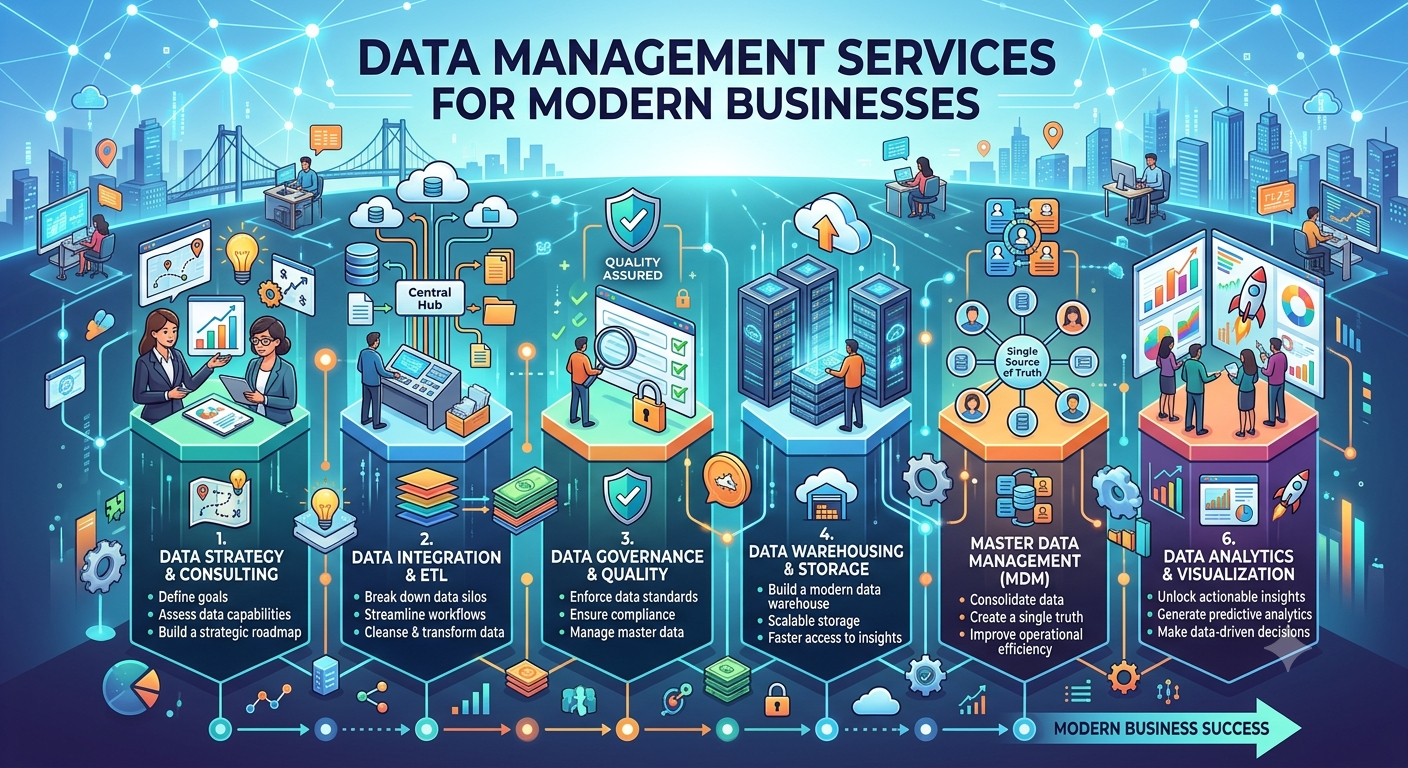
Leading data management platform providers and service firms focus on several interconnected pillars.
Master Data Management (MDM)
Master data management creates a single, authoritative source of truth for core business entities like customers, products, or suppliers. MDM prevents duplication and inconsistencies that plague many organizations.
Data Integration and ETL Processes
What is MDM and ETL?
ETL stands for Extract, Transform, Load the process of pulling data from various sources, cleaning and standardizing it, and loading it into a central repository. Modern data management tools automate much of this workflow.
Data Governance and Quality
Governance establishes rules, roles, and responsibilities around data handling. Quality management ensures accuracy, completeness, and reliability.
Security and Compliance
Services include encryption, access controls, auditing, and breach response planning.
Analytics and Visualization
Advanced data management solutions incorporate tools for turning data into insights through dashboards and predictive modeling.
The 5 Pillars of Data Management
What are the 5 pillars of data management? Frameworks often highlight:
- Data Quality Accuracy and reliability.
- Data Integration Combining sources seamlessly.
- Data Governance Policies and oversight.
- Data Security Protection against threats.
- Data Lifecycle Management Handling data from creation to archival or deletion.
These pillars form the foundation of effective data management system implementations.
Benefits of Professional Data Management Services
Engaging external data management services offers several advantages:
- Expertise and Best Practices: Access to specialists familiar with latest technologies and regulations.
- Scalability: Solutions that grow with your data needs without massive internal investment.
- Faster Implementation: Proven methodologies accelerate time-to-value.
- Risk Reduction: Professional handling of compliance and security complexities.
- Cost Efficiency: Avoiding expensive mistakes or redundant systems.
For growing companies, these services often deliver ROI through improved efficiency and better decision-making.
Implementing Data Management Solutions: A Step-by-Step Approach
Successful adoption typically follows these phases:
- Assessment: Evaluate current data landscape, pain points, and goals.
- Strategy Development: Define architecture, governance framework, and priorities.
- Technology Selection: Choose appropriate data management software and platforms.
- Integration and Migration: Safely move and connect existing data.
- Training and Adoption: Ensure teams understand and utilize new systems.
- Monitoring and Optimization: Continuous improvement based on performance metrics.
Data management platform selections should consider scalability, ease of use, and integration capabilities with existing tools.
Challenges in Data Management and How Services Help
Common obstacles include data silos, quality issues, talent shortages, and rapidly evolving regulations. Professional services mitigate these through standardized processes, automated tools, and ongoing support.
Data management jobs within organizations often focus on specialized areas like governance or analytics, complementing external expertise.
Comparison of Data Management Approaches
| Approach | Best For | Pros | Cons | Cost Considerations |
|---|---|---|---|---|
| In-House Team | Large enterprises with complex needs | Full control, customization | High hiring and training costs | Significant ongoing |
| Managed Services | Mid-sized businesses | Expertise without full staff | Less internal knowledge | Predictable monthly fees |
| Cloud-Native Platforms | Scalable, modern operations | Easy scaling, reduced maintenance | Vendor dependency | Usage-based pricing |
| Hybrid Solutions | Most organizations | Flexibility and control | Integration complexity | Balanced investment |
This table illustrates trade-offs to consider when evaluating data management solutions.
Future Trends in Data Management Services
Emerging developments include greater AI integration for automated governance, real-time data processing, privacy-enhancing technologies, and edge computing support. Data management platform providers increasingly emphasize sustainability and ethical data use.
Businesses that partner with forward-thinking service providers position themselves to leverage these advancements effectively.
Choosing the Right Data Management Partner
Look for providers with:
- Proven industry experience.
- Comprehensive service portfolios covering governance through analytics.
- Strong security credentials and compliance track records.
- Clear implementation methodologies and support structures.
- Transparent pricing and measurable outcomes.
Request case studies and references from similar organizations.
FAQ: Data Management Services
1. What are data management services?
Professional offerings that help organizations collect, organize, secure, and utilize their data effectively through strategy, tools, and expertise.
2. What is CDM and CRM in data contexts?
CDM often refers to Clinical Data Management in healthcare, while CRM is Customer Relationship Management both rely heavily on robust data practices.
3. How do master data management solutions help businesses?
They create consistent, accurate core records that prevent errors and improve decision-making across systems.
4. What should I look for in data management software?
Scalability, integration capabilities, security features, user-friendliness, and strong analytics support.
5. Are data management jobs in high demand?
Yes, as organizations recognize data as a strategic asset requiring specialized skills in governance, quality, and architecture.
6. How do data management tools support compliance?
Through auditing, access controls, data lineage tracking, and automated policy enforcement.
7. What is the difference between data management and data analytics?
Data management focuses on handling and preparing information, while analytics extracts insights from well-managed data.
Conclusion
Data management services for modern businesses provide the foundation for informed decision-making, operational efficiency, and innovation. By addressing quality, governance, security, and integration comprehensively, these services transform data from a potential liability into a strategic advantage.