






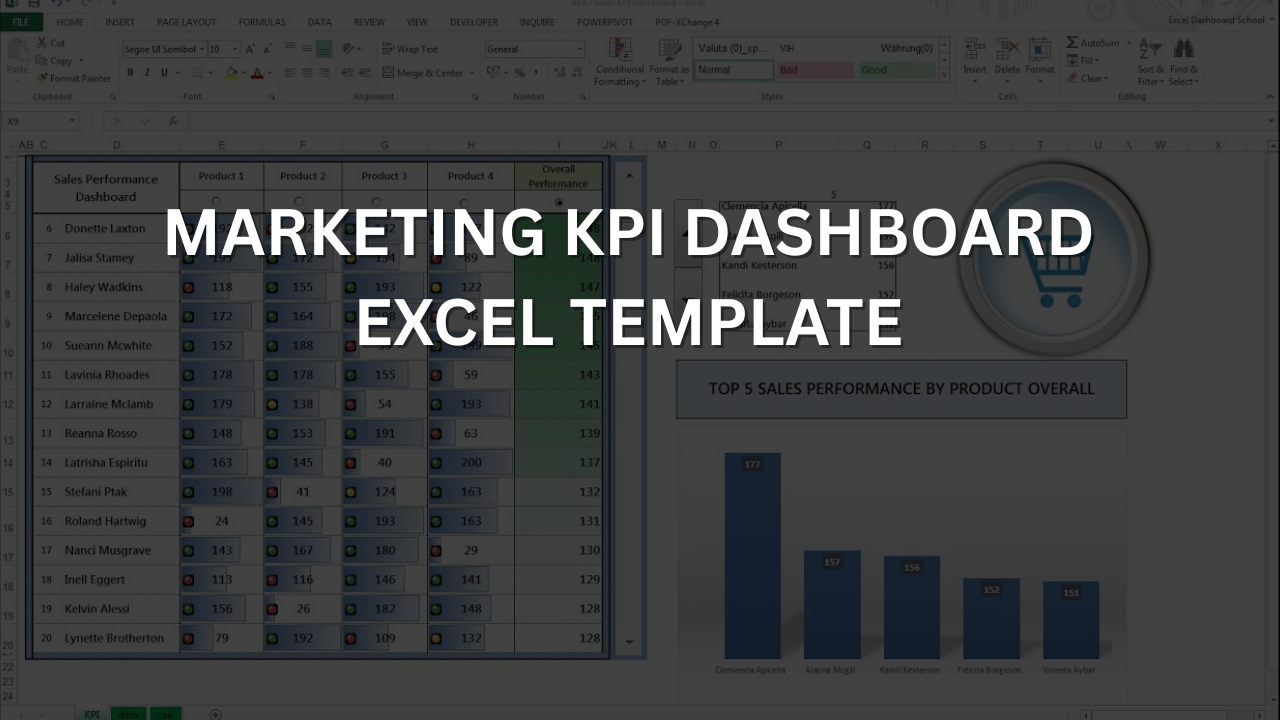
In today’s fast-paced digital landscape, marketers juggle multiple channels, campaigns, and metrics to drive results. A marketing KPI dashboard Excel template serves as a centralized tool to track performance, spot trends, and make data-driven decisions without needing expensive software. Whether you’re optimizing SEO, social media, or email campaigns, customizing such a template ensures it aligns with your unique strategy. This approach not only saves time but also empowers teams to focus on growth rather than manual reporting. With free options available, like a marketing KPI dashboard Excel template free download, anyone can start building insights quickly. In this guide, we’ll explore how to tailor these templates effectively, drawing from real-world examples and best practices.
What is a KPI Dashboard in Excel?
A KPI dashboard in Excel is essentially a visual summary of key performance indicators (KPIs) pulled from your data sources into one spreadsheet. It uses charts, graphs, and conditional formatting to display metrics like conversion rates, customer acquisition costs, and ROI at a glance. Unlike static reports, these dashboards update dynamically with formulas and pivot tables, making them ideal for ongoing analysis.
For marketers, a marketing dashboard Excel goes beyond basic tracking. It integrates data from tools like Google Analytics, CRM systems, or ad platforms, providing a holistic view of campaign effectiveness. This setup answers critical questions: Are your efforts generating leads? What’s the return on ad spend? By centralizing data, it reduces errors from scattered spreadsheets and speeds up decision-making.
Benefits of Using a Marketing KPI Dashboard Excel Template
Starting with a pre-built marketing KPI Excel template free download offers several advantages. First, it eliminates the need to build everything from scratch, which can be time-consuming for non-technical users. Templates often include ready-made formulas, charts, and layouts, allowing you to plug in your data and customize as needed.
Another key benefit is accessibility. Excel is widely available, and these templates work offline, unlike cloud-based tools that require subscriptions. For small teams or freelancers, this means cost savings while maintaining professional-grade reporting. Plus, customization lets you adapt the dashboard to specific strategies, such as content marketing or paid ads, ensuring relevance.
Deep insights come from real-time visibility. For instance, tracking trends over time can reveal seasonal patterns in customer behavior, helping refine strategies. Avoid common pitfalls like overloading the dashboard with too many metrics focus on 5-10 core KPIs to keep it actionable.
Key Marketing KPIs to Include in Your Dashboard
Selecting the right KPIs is crucial for any marketing KPI dashboard Excel template. These metrics should tie directly to your goals, whether it’s increasing brand awareness or boosting sales. Here’s a breakdown of essential ones:
| KPI | Description | Formula/Example | Why It Matters |
|---|---|---|---|
| Customer Acquisition Cost (CAC) | Total cost to acquire a new customer, including ad spend and salaries. | =Total Marketing Spend / New Customers Acquired | Measures efficiency of acquisition strategies; lower CAC indicates better ROI. |
| Return on Investment (ROI) | Profit generated from marketing efforts relative to costs. | =(Revenue – Cost) / Cost * 100 | Shows overall campaign profitability; aim for at least 5:1 ratio in competitive markets. |
| Conversion Rate | Percentage of visitors who take a desired action, like signing up. | =Conversions / Total Visitors * 100 | Highlights funnel effectiveness; benchmarks vary by industry (e.g., 2-5% for e-commerce). |
| Click-Through Rate (CTR) | Ratio of clicks to impressions on ads or emails. | =Clicks / Impressions * 100 | Gauges ad relevance; higher CTR (above 2%) suggests compelling creatives. |
| Customer Lifetime Value (CLV) | Predicted net profit from a customer’s entire relationship. | =Average Purchase Value * Purchase Frequency * Lifespan | Informs long-term strategy; compare to CAC for sustainability. |
| Lead Generation Rate | Number of leads per campaign or channel. | =Leads Generated / Total Opportunities | Tracks top-of-funnel performance; essential for B2B marketing. |
| Bounce Rate | Percentage of visitors leaving after one page. | From Google Analytics data import | Indicates content quality; under 40% is ideal for engagement-focused sites. |
Finding the Right Marketing KPI Dashboard Excel Template Free Download
With numerous options online, choosing a marketing KPI dashboard Excel template free can be overwhelming. Look for templates that are flexible, with editable charts and data connections. Popular sources include HubSpot’s free marketing dashboard template, which integrates with Google Sheets for collaboration, or Smartsheet’s collection of 14 marketing dashboard examples in Excel.
For a marketing KPI dashboard Excel template download, sites like TemplateLab offer over 20 KPI dashboard templates, including excel KPI dashboard examples tailored for marketing. Ensure the template supports pivot tables for dynamic filtering. Free versions from Databox provide 200+ marketing dashboard examples, connectable to your data sources. Always download from reputable sites to avoid malware.
If you’re in sales-aligned marketing, consider a sample sales dashboard in Excel, which can be adapted for hybrid strategies.
Step-by-Step Guide: How to Create and Customize a KPI Dashboard in Excel
While you can build from scratch, starting with a marketing KPI dashboard Excel template free download is smarter. Here’s how to customize it for any strategy:
Step 1: Prepare Your Data
Import raw data from sources like CSV exports or APIs. Clean it using Excel’s Power Query to remove duplicates and format dates. Define your dashboard’s purpose e.g., tracking quarterly campaigns and select relevant KPIs.
Step 2: Set Up the Layout
Use separate sheets: one for raw data, another for calculations, and a main dashboard view. Add slicers for interactive filtering by channel or time period. This makes your marketing dashboard Excel user-friendly.
Step 3: Build Visualizations
Insert charts via Insert > Charts. For KPIs, use sparklines for trends or conditional formatting (Data > Conditional Formatting) to color-code performance (green for good, red for alerts). Formulas like =SUMIF() aggregate data dynamically.
Step 4: Add Calculations and Formulas
Incorporate the KPIs from our table. For ROI, link cells to auto-update. Use VLOOKUP or INDEX-MATCH for cross-referencing data sets. Test with sample data to ensure accuracy.
Step 5: Customize for Your Strategy
Tailor to specifics: For content marketing, add metrics like page views; for PPC, include ROAS. Adjust colors and fonts to match branding. If collaborating, protect sheets to prevent accidental changes.
Step 6: Automate and Test
Link to external data via Data > Get Data for real-time updates. Run scenarios with What-If Analysis to forecast outcomes. Share via OneDrive for team access.
Common mistake: Ignoring mobile view use freeze panes for better navigation.
Marketing KPI Dashboard Examples
Real-world marketing KPI dashboard examples illustrate customization. HubSpot’s template visualizes email metrics like open rates and unsubscribes, ideal for inbound strategies. Zapier’s KPI dashboard focuses on business analytics, adaptable for marketing with ROI charts.
For excel KPI dashboard examples, Vena Solutions offers dynamic templates with quarterly spend breakdowns. Etsy sells a weekly marketing KPI dashboard for campaigns, featuring automated ROI charts. These show how templates evolve from basic to advanced with add-ons like macros.
In a social media example, track follower growth and engagement using line graphs. For e-commerce, integrate sales data for a sample sales dashboard in Excel, blending marketing and revenue metrics.
Advanced Tips for Excel Marketing Dashboard Templates
To elevate your setup, use Power BI integration for more complex visuals, though stick to Excel for simplicity. Add alerts with VBA scripts for threshold notifications. For large datasets, optimize with array formulas to avoid slowdowns.
Incorporate LSI elements like trend analysis to predict future performance. Regularly audit your dashboard remove outdated KPIs to maintain focus. For global teams, use currency conversions in formulas.
Security tip: Password-protect sensitive data sheets. Explore free add-ins like Kutools for enhanced charting.
FAQ
What is the best marketing KPI dashboard Excel template free download?
HubSpot and Smartsheet offer reliable free templates with customizable charts for various strategies.
How do I integrate data from Google Analytics into my marketing dashboard Excel?
Use Excel’s Get Data feature to import via web queries or APIs, then link to your dashboard sheets for automatic updates.
Can I use a marketing KPI dashboard Excel template for social media tracking?
Yes, customize with metrics like engagement rate and reach, using pivot charts for platform-specific views.
What are common mistakes when creating a KPI dashboard in Excel?
Overcomplicating with too many KPIs or neglecting data cleaning, which leads to inaccurate insights.
Is there a difference between a marketing KPI dashboard and a sample sales dashboard in Excel?
Marketing focuses on lead gen and awareness, while sales emphasizes revenue and pipelines, but they often overlap in templates.
How often should I update my Excel marketing dashboard templates?
Weekly for active campaigns, monthly for strategic overviews, to catch trends early.
Where can I find marketing KPI dashboard examples for inspiration?
Sites like Databox and Geckoboard provide 17+ real-company examples across channels.
Conclusion
Customizing a marketing KPI dashboard Excel template empowers you to align metrics with any strategy, from lead generation to ROI optimization. By following the steps outlined, incorporating key KPIs via tables, and drawing from examples, you’ll create a powerful tool for success. Start with a marketing KPI dashboard Excel template download today head to HubSpot’s free resources or Smartsheet templates to get going. What strategy will you track first? Share your experiences in the comments below.