








In the competitive world of sales, managing customer relationships efficiently can make or break your business. Pipedrive stands out as a powerful sales CRM and lead management software designed with visual pipelines that help teams close more deals. But its true strength lies in its ecosystem of connections. Mastering pipedrive integrations transforms the platform from a simple deal tracker into a centralized hub for your entire sales tech stack.
This comprehensive guide explains pipedrive integrations setup and configuration in detail. Whether you’re new to pipedrive crm or looking to optimize an existing account, you’ll find practical steps, best practices, and insights to maximize value. We’ll cover everything from basic setup to advanced API usage, comparisons with alternatives like HubSpot CRM and Zoho CRM, and troubleshooting common pipedrive issues.
What Is Pipedrive and Why Integrations Matter
Pipedrive is a user-friendly CRM system focused on pipeline management, activities, and sales forecasting. It helps sales teams organize leads, track deals, and automate repetitive tasks. With plans starting affordably, it’s popular among small to medium businesses seeking a straightforward yet powerful tool.
Pipedrive integrations connect the CRM to email, marketing tools, accounting software, communication platforms, and more. These connections eliminate data silos, automate workflows, and provide a 360-degree view of customer interactions. Without integrations, teams waste time switching between apps; with them, productivity soars.
Popular secondary tools include pipedrive login for access, exploring pipedrive pricing options, requesting a pipedrive demo, and reviewing the pipedrive logo for branding familiarity. Many users also search for pipedrive crm pricing details and pipedrive api documentation.
Getting Started: Pipedrive Login and Initial Setup
Before diving into integrations, ensure your account is ready:
- Visit the Pipedrive website and complete pipedrive login (or sign up for a 14-day free trial).
- Set up your pipeline stages, import contacts, and configure basic settings.
- Navigate to Settings > Personal Preferences for email sync and notifications.
A clean initial setup makes pipedrive integrations smoother. For visual guidance, check official pipedrive demo resources or YouTube tutorials.
Exploring the Pipedrive Marketplace
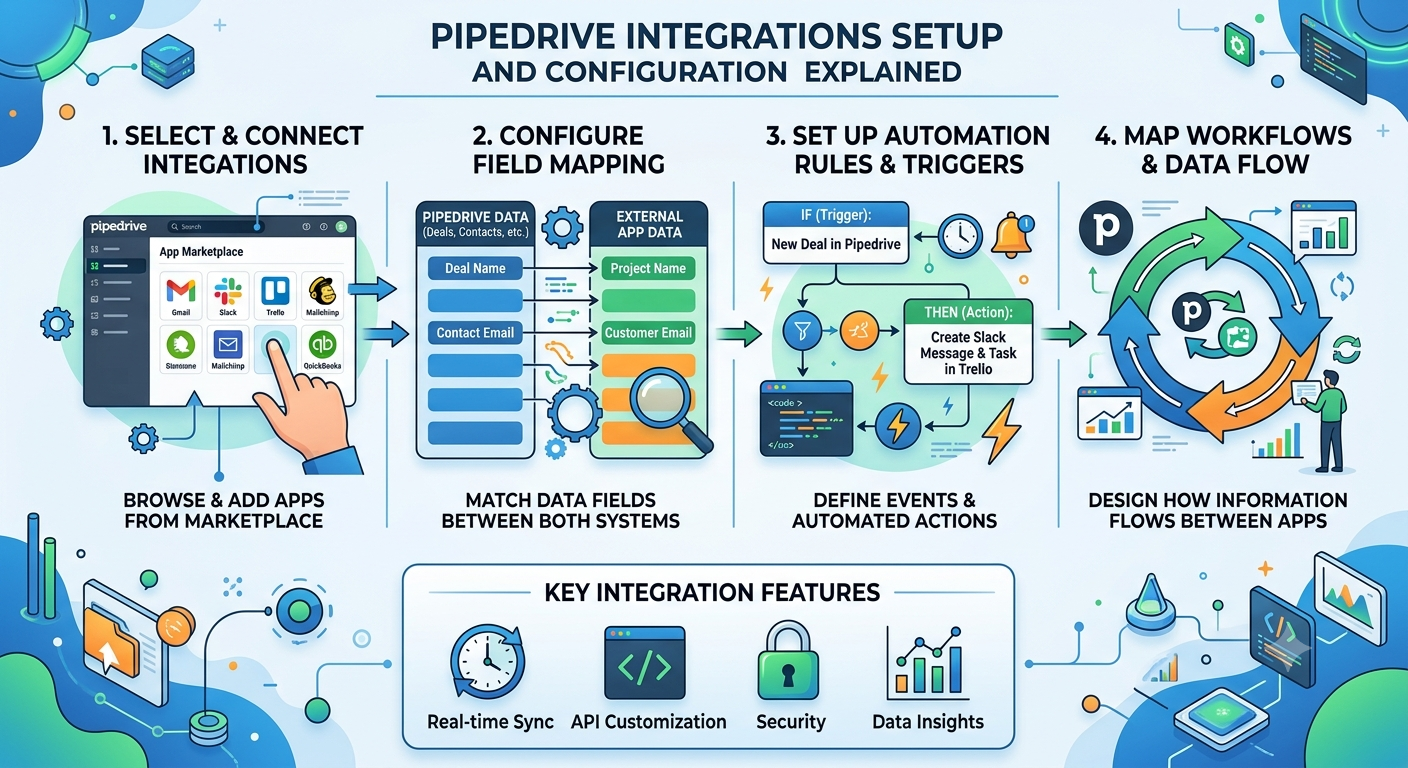
The official Pipedrive Marketplace is your starting point for hundreds of native integrations. Categories include lead generation, communication, productivity, accounting, and marketing.
To install an integration:
- Log into your Pipedrive account.
- Go to the Marketplace from the left sidebar or dashboard.
- Search for the app (e.g., Slack, Zoom, or Mailchimp).
- Click Install and authorize the connection.
- Configure sync preferences, such as which data fields to map.
Most setups take just a few minutes. Popular native options include Gmail/Outlook email sync, which logs conversations automatically against deals and contacts.
Step-by-Step Pipedrive Integrations Setup and Configuration
Here’s how to configure common integrations effectively:
Email and Communication Integrations
Syncing email is foundational. In Personal Preferences > Sync Email, connect Gmail or Outlook. Grant necessary permissions for two-way sync. This ensures every email ties back to the right deal, reducing manual entry.
For phone and messaging, integrate tools like CloudTalk or JustCall for click-to-call and automatic logging.
Marketing and Lead Generation
Connect lead sources like Facebook Lead Ads, LinkedIn, or tools such as Leadfeeder and Wishpond. These push qualified leads directly into your Pipedrive pipeline. Configure webhooks or use automation rules to score and assign leads automatically.
Productivity and Project Management
Integrate with Slack for notifications, Trello or Asana for task handoffs, and Google Workspace or Microsoft 365 for calendar syncing. Set up Zapier for custom “if-this-then-that” automations when native options are limited.
Accounting and Finance
Link Xero or QuickBooks to sync deal values and invoices. This closes the loop from lead to revenue tracking.
Advanced: Using the Pipedrive API
For custom needs, explore pipedrive api documentation. Every plan includes free API access with a personal token.
- Generate your API token in Settings > Personal Preferences > API.
- Use RESTful endpoints to create deals, update contacts, or build custom dashboards.
- Refer to the official developer docs and OpenAPI specs for code examples in PHP, Node.js, etc.
Custom integrations suit businesses with unique workflows but require developer resources.
Pipedrive Pricing and Plan Considerations for Integrations
Pipedrive pricing impacts available features:
- Lite: Basic pipeline tools and some integrations (starting ~$14/user/month annually).
- Growth: Adds full email sync and automations.
- Premium/Professional: Advanced reporting, forecasting, and more integrations.
- Ultimate/Enterprise: Unlimited customization, advanced security, and priority support.
Higher tiers unlock deeper automation and API usage limits. Always review current pipedrive crm pricing on the official site, as it includes annual discounts. A pipedrive demo helps evaluate fit before committing.
Comparing Pipedrive with Other CRM Systems
When evaluating pipedrive integrations, consider alternatives:
| Feature/Aspect | Pipedrive | HubSpot CRM | Zoho CRM |
|---|---|---|---|
| Pricing (entry) | Affordable per user | Free tier available | Flexible, scalable |
| Pipeline Focus | Visual, sales-oriented | Inbound marketing heavy | Customizable modules |
| Integrations Marketplace | 500+ apps | Extensive | Strong ecosystem |
| Ease of Use | High (Kanban-style) | Moderate | Moderate to high |
| Best For | SMB sales teams | Marketing-led companies | All-in-one businesses |
| API Access | Free with all plans | Robust | Comprehensive |
Pipedrive excels in simplicity for deal-focused teams, while HubSpot CRM offers strong free marketing tools, and Zoho CRM provides broad customization. Many businesses use Hubspot pipedrive syncs for hybrid setups.
Other related products include general free CRM options for startups, dedicated lead management software, and full sales CRM suites.
Best Practices for Successful Configuration
- Start simple: Integrate 2-3 core tools first (email, calendar, one marketing app).
- Map data carefully: Ensure fields align to avoid duplicates or missing information.
- Automate thoughtfully: Use rules to move deals based on triggers without overcomplicating.
- Train your team: Document workflows and conduct sessions on new integrations.
- Monitor performance: Regularly review sync logs and usage analytics in Pipedrive.
- Security first: Review permissions during authorization and comply with GDPR.
Common Pipedrive Issues and Troubleshooting
Pipedrive issues often relate to login, sync failures, or performance:
- Login problems: Clear browser cache, try incognito mode, or reset password. Check for two-factor authentication issues.
- Sync delays: Verify permissions and reconnect the app.
- API errors: Double-check tokens and refer to pipedrive api documentation.
- Slow performance: Update browsers, reduce open tabs, or contact support.
The Pipedrive status page and knowledge base are excellent resources.
Pipedrive Resources and Further Learning
- Official pipedrive login portal.
- Marketplace for discovering new tools.
- Developer docs for API.
- Blog and Academy for tips.
- Community forums for peer advice.
Search trends show interest in pipedrive integrations login, pipedrive resources, and comparisons.
FAQ: Pipedrive Integrations and Setup
1. How do I find and install Pipedrive integrations?
Access the Marketplace from your dashboard, search, install, and authorize. Most are plug-and-play.
2. What is the Pipedrive API and how do I use it?
It’s a RESTful interface for custom connections. Generate a token in settings and consult the pipedrive api documentation for endpoints.
3. Does Pipedrive offer a free plan or trial?
Yes, a 14-day trial is available. Limited free options exist, but paid plans unlock full features and integrations.
4. How much does Pipedrive cost?
Plans start around $14–$24 per user/month (billed annually). Check current pipedrive pricing or pipedrive crm pricing for details.
5. Can I integrate Pipedrive with HubSpot?
Yes, through native options or Zapier for bidirectional data flow.
6. What should I do if an integration stops working?
Reauthorize the connection, check permissions, and review error logs. Update apps as needed.
7. Is Pipedrive suitable for large teams?
Yes, especially on higher plans with advanced permissions, reporting, and scalability.
Conclusion
Effective pipedrive integrations setup and configuration can revolutionize your sales process, turning scattered tools into a cohesive system that drives results. By starting with core connections like email and calendars, leveraging the Marketplace, and exploring the API for advanced needs, you’ll unlock the full potential of this sales CRM.