In a crowded digital marketplace, shouting louder rarely works. Success comes from speaking directly to the right people with messages that resonate. Understanding how to reach target audience effectively separates thriving businesses from those struggling with low engagement and wasted ad spend. Whether you’re a startup founder, marketer, or small business owner, mastering this skill drives higher conversions, stronger loyalty, and sustainable growth.
This guide breaks down everything from target audience definition to practical strategies for 2026 and beyond. You’ll learn what is a target audience, how to research your target audience, segmentation techniques, and channel-specific tactics including instagram target audience optimization.
What Is a Target Audience? Definition and Meaning
Target audience meaning refers to the specific group of people most likely to be interested in your product, service, or message. A target audience definition narrows the broad market to individuals sharing common traits who are ready to engage or buy.
What is target audience in simple terms? It’s not “everyone.” It’s the subset that aligns with your offering defined by demographics, interests, behaviors, and needs. Misidentifying this group leads to irrelevant content and poor ROI. Getting it right allows personalized messaging that feels like a conversation rather than a broadcast.
Importance of target audience cannot be overstated. It focuses efforts, reduces costs, and improves relevance in an era of short attention spans and ad fatigue.
Target Audience Segmentation: The Foundation
Target audience segmentation divides your potential customers into meaningful groups for tailored approaches. Common types include:
- Demographic: Age, gender, income, education, occupation.
- Geographic: Location, climate, urban/rural.
- Psychographic: Lifestyle, values, attitudes, interests.
- Behavioral: Purchase habits, brand loyalty, usage rate.
What are the 7 types of audiences? Variations often expand to include technographic (tech usage), transactional (purchase history), contextual (environment), and predictive (AI-forecasted behavior).
Effective segmentation reveals opportunities, such as creating different campaigns for budget-conscious vs. premium-seeking segments.
How to Research Your Target Audience
How to research your target audience involves systematic data collection. Skip assumptions rely on evidence.
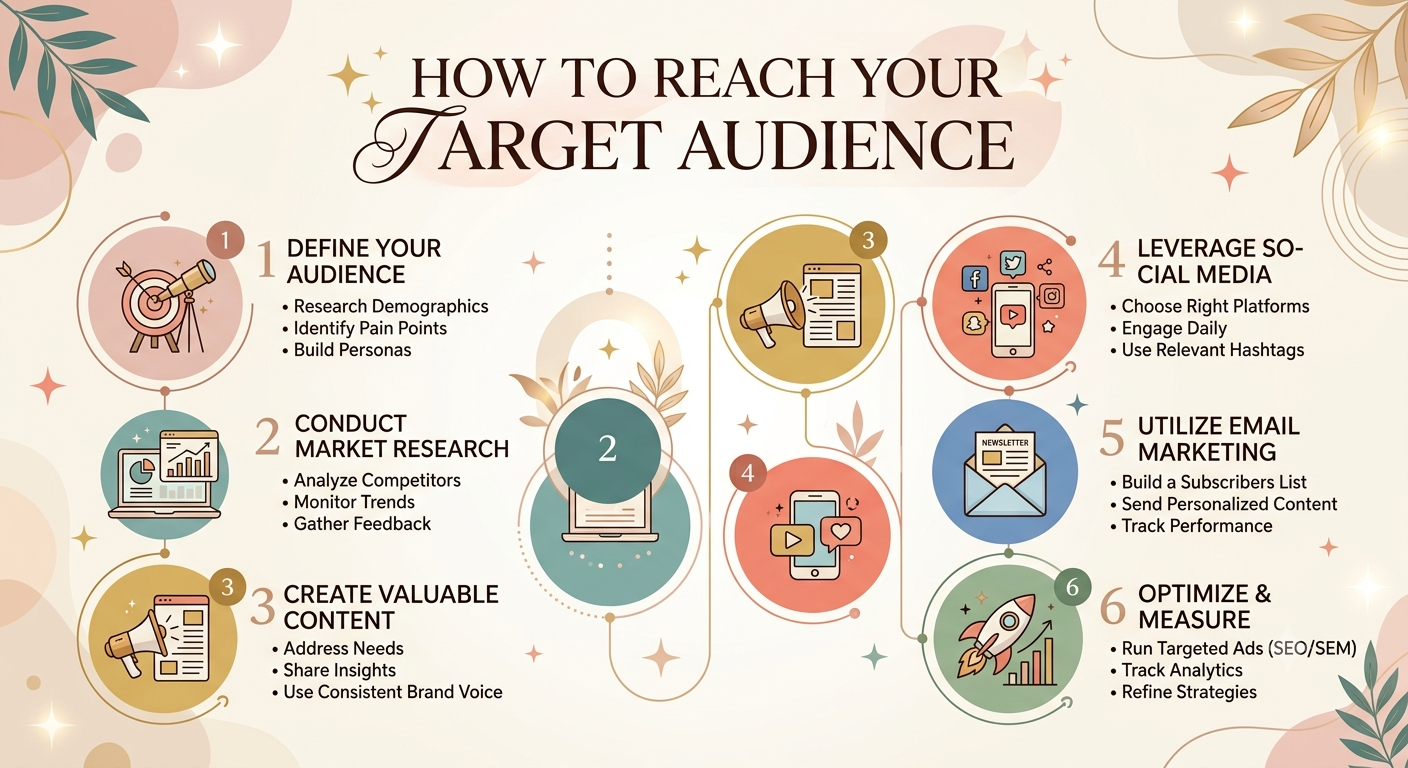
- Analyze Existing Data: Review website analytics, CRM records, and sales history for patterns.
- Surveys and Interviews: Ask current customers about pain points and preferences.
- Social Listening: Monitor conversations on platforms like Instagram, Reddit, or Twitter.
- Competitor Analysis: Study who competitors target and their messaging.
- Tools and Platforms: Use Google Analytics, social insights, or AI-powered audience tools.
Target audience research should be ongoing. Markets evolve, and so do customer needs. Create buyer personas fictional yet data-backed profiles to humanize segments.
Target audience example: A fitness app might target “busy urban professionals aged 25-40 who value convenience and track macros via apps.”
Target audience analysis combines quantitative data (numbers) with qualitative insights (motivations) for deeper understanding.
The 4 Targeting Strategies
What are the 4 targeting strategies?
- Undifferentiated (Mass) Marketing: One message for all rarely effective today.
- Differentiated Marketing: Separate campaigns for different segments.
- Concentrated (Niche) Marketing: Focus on one specific segment.
- Micromarketing: Hyper-personalized for individuals or small groups.
Choose based on resources and product type. Most modern businesses blend differentiated and micromarketing using data.
How to Reach Target Audience: Proven Strategies
How to attract my target audience? Focus on value, visibility, and connection.
Content Marketing and SEO
Create educational, problem-solving content that ranks in search. Address queries like “how to reach target audience in marketing” through blog posts and guides. Optimize for voice search and featured snippets.
Social Media and Instagram Target Audience
Platforms like Instagram excel at visual targeting. For instagram target audience:
- Use Insights to analyze follower demographics and active times.
- Employ relevant hashtags, geotags, and Reels.
- Engage in communities and collaborate with influencers in your niche.
- Run targeted ads based on interests and behaviors.
Build authentic relationships rather than pushing sales.
Email and Personalized Outreach
Email remains highly effective. Segment lists and personalize subject lines and content. Nurture leads with valuable sequences.
Paid Advertising
Use platforms like Google Ads, Facebook/Instagram Ads, or LinkedIn for precise demographic and interest targeting. Test creatives and refine based on performance.
Community Building and Partnerships
Participate in forums, host webinars, or partner with complementary brands. This builds trust organically.
What is the 3-3-3 rule in marketing? One interpretation emphasizes reaching audiences across three channels, with three touchpoints, over three months for better retention highlighting the need for consistent, multi-channel presence.
How to Reach Target Audience in Business and Marketing Examples
How to reach target audience in business: A local coffee shop might use Instagram geotags and loyalty apps to attract nearby young professionals. An SaaS tool could leverage LinkedIn ads and content syndication for B2B decision-makers.
How to reach target audience example in marketing: A sustainable clothing brand researches eco-conscious millennials via surveys, segments by values (psychographic), and reaches them through Instagram Reels showing ethical production and influencer partnerships.
Advertising target audience strategies often combine lookalike audiences on social platforms with retargeting for warmer leads.
Challenges and Best Practices
Common pitfalls include outdated research or over-generalization. Stay agile:
- Regularly update personas.
- Test messages with A/B splits.
- Measure engagement metrics beyond vanity (clicks, conversions).
- Balance automation with human touch for authenticity.
- Comply with privacy regulations like GDPR.
In 2026, AI aids personalization while genuine connection differentiates brands.
Comparison of Channels for Reaching Target Audience
| Channel | Best For | Pros | Cons | Example Targeting |
|---|---|---|---|---|
| Visual, younger audiences | High engagement, stories/reels | Algorithm changes | Hashtags + interest ads | |
| Nurturing & retention | Direct, measurable | Deliverability issues | Behavioral segmentation | |
| SEO/Content | Long-term organic reach | Builds authority | Takes time | Search intent keywords |
| Paid Social/Ads | Quick scaling | Precise demographics | Costly if not optimized | Lookalike + retargeting |
| Communities/Events | Trust-building | Authentic connections | Time-intensive | Niche forums or webinars |
This table helps prioritize based on your target audience profile and goals.
FAQ: How to Reach Target Audience
1. What is a target audience in marketing?
It’s the specific group most likely to respond to your offerings, defined by shared characteristics.
2. How do I find my target audience?
Through research methods like surveys, analytics, and competitor study. Create detailed personas.
3. What are effective ways to reach target audience on Instagram?
Analyze Insights, use strategic hashtags, create engaging Reels, and run targeted ads.
4. How does target audience segmentation help?
It enables tailored messaging, improving relevance and conversion rates.
5. What is the importance of target audience analysis?
It prevents wasted resources and ensures marketing addresses real needs and preferences.
6. How to reach target audience in marketing with limited budget?
Focus on organic content, SEO, community engagement, and email before scaling paid ads.
7. Are there different types of targeting strategies?
Yes undifferentiated, differentiated, concentrated, and micromarketing.
Conclusion
Learning how to reach target audience is an ongoing process of research, segmentation, testing, and adaptation. By defining what is a target audience, conducting thorough target audience research, and deploying multi-channel strategies, you create meaningful connections that drive results.