



Every business wants more customers, but turning strangers into loyal buyers requires a structured approach. This is where understanding what is a sales funnel becomes essential. A well-designed sales funnel guides prospects through a deliberate journey, nurturing interest until they convert into paying customers.
In competitive markets, random marketing efforts waste resources. A sales funnel that increases conversions focuses efforts at each stage, reduces drop-offs, and maximizes ROI. This guide explains the concept, stages, examples, and actionable steps for building one whether for B2C or complex B2B sales funnel scenarios.
What Is Meant by Sales Funnel?
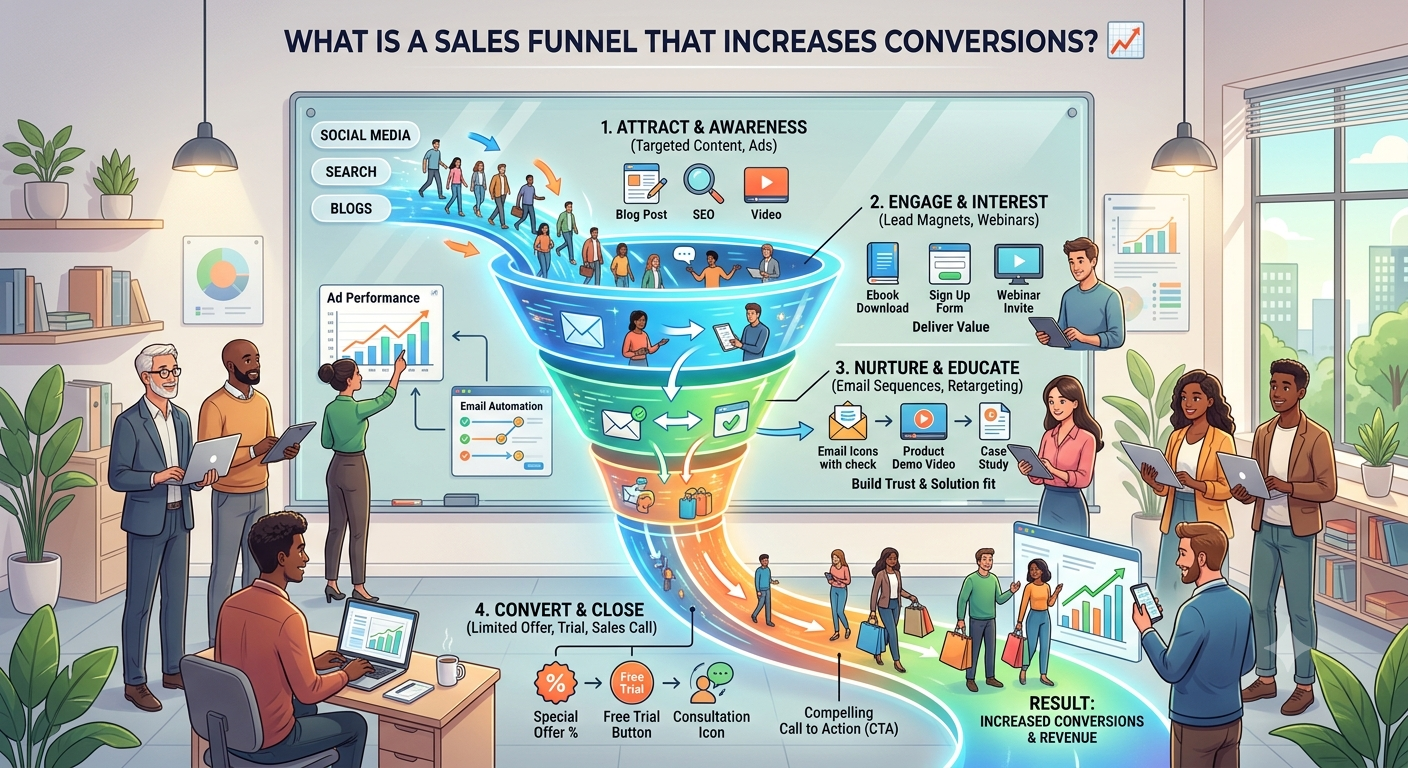
A sales funnel visualizes the customer journey from initial awareness to final purchase. It resembles an inverted pyramid: wide at the top with many prospects and narrowing toward the bottom as fewer convert.
What is a sales funnel in practical terms? It maps the steps buyers take, helping businesses align marketing, sales, and support. Unlike a linear path, it accounts for drop-offs while identifying optimization opportunities.
The core idea traces back to models like AIDA (Awareness, Interest, Desire, Action). Modern funnels incorporate data, automation, and personalization for better results. Effective funnels shorten sales cycles and improve win rates by addressing objections proactively.
Sales Funnel Stages Explained
Most funnels break into clear phases. A common framework includes:
1. Awareness (Top of Funnel – TOFU) Prospects discover your brand through ads, content, or referrals. They recognize a problem but may not know solutions exist. Goal: Attract qualified traffic.
2. Interest/Consideration (Middle of Funnel – MOFU) Prospects engage downloading resources, subscribing, or researching options. They evaluate if your offering fits. Goal: Build trust and educate.
3. Decision/Intent (Bottom of Funnel – BOFU) Leads compare providers and show buying signals. Goal: Address concerns and facilitate easy purchase.
4. Action/Purchase & Retention Conversion happens, followed by onboarding and loyalty efforts. Goal: Close deals and encourage repeats or referrals.
B2B sales funnel stages often expand with longer cycles, involving multiple stakeholders, demos, and negotiations. B2C versions move faster with impulse elements.
Sales Funnel Examples in Action
Real-world applications clarify the concept:
- E-commerce Example: A clothing brand runs Instagram ads (Awareness). Visitors browse and add to cart (Interest). Abandoned cart emails with discounts nudge decisions (Decision). Post-purchase upsells and loyalty programs retain customers.
- B2B SaaS Example: A marketing automation tool shares blog posts on LinkedIn (Awareness). Prospects download a guide and join webinars (Interest). Sales teams offer personalized demos and trials (Decision). Successful users upgrade and refer others.
What is an example of a sales funnel? These show how content and touchpoints move people forward. Tailor examples to your industry for relevance.
How to Create a Sales Funnel That Increases Conversions
Building an effective funnel involves strategy and iteration.
Step 1: Define Your Audience and Goals Research ideal customer profiles (ICPs). Set measurable targets like conversion rates or revenue per stage.
Step 2: Map the Stages Outline buyer journey touchpoints. Identify content or actions for each phase.
Step 3: Create Targeted Content and Offers
- TOFU: Blog posts, social media, videos.
- MOFU: Ebooks, webinars, case studies.
- BOFU: Demos, trials, consultations, limited-time offers.
Step 4: Implement Tools and Automation Use CRM systems, email sequences, landing pages, and analytics (e.g., Google Analytics, HubSpot) for tracking.
Step 5: Test, Measure, and Optimize Monitor metrics like drop-off rates and A/B test elements. The 10-3-1 rule in sales illustrates realism: roughly 10 leads might yield 3 opportunities and 1 sale. Use it to set volume expectations.
Step 6: Focus on Retention Post-purchase nurturing turns customers into advocates.
Sales Funnel Management Best Practices
Sales funnel management keeps the system efficient:
- Maintain visibility with dashboards.
- Standardize processes across teams.
- Align marketing and sales.
- Regularly audit for bottlenecks.
- Leverage data for personalization.
Consistent review prevents stagnation. Tools help automate follow-ups while humans handle complex interactions, especially in B2B.
Table: Sales Funnel Stages with Strategies and Metrics
| Stage | Goal | Key Tactics | Success Metrics |
|---|---|---|---|
| Awareness | Attract prospects | Content marketing, ads, SEO | Traffic, impressions, reach |
| Interest | Engage and educate | Lead magnets, newsletters | Leads generated, open rates |
| Decision | Overcome objections | Demos, comparisons, testimonials | Opportunities, proposal views |
| Action | Close the sale | Discounts, easy checkout | Conversion rate, revenue |
| Retention | Build loyalty | Onboarding, upsells, support | Retention rate, referrals |
This framework helps track progress and spot improvements.
Common Challenges and Solutions
Leaky funnels lose prospects at weak points. Solutions include better segmentation, faster responses, and value-focused content. In B2B, longer cycles demand patience and multi-touch nurturing.
Avoid over-automation that feels impersonal. Balance technology with genuine connection.
FAQ: Sales Funnels
What is meant by sales funnel?
A sales funnel describes the journey prospects take from awareness to purchase, helping businesses guide and convert them effectively.
What is an example of a sales funnel?
An e-commerce site using ads to drive traffic, email sequences for nurturing, and checkout optimization for sales. B2B examples involve webinars leading to consultations.
What is the 10-3-1 rule in sales?
It suggests that for every 10 qualified leads, about 3 become opportunities, resulting in 1 closed sale. It sets realistic expectations for volume.
How do you build a sales funnel?
Identify your audience, map stages, create content, implement tools, and optimize based on data.
What are typical sales funnel stages?
Awareness, Interest, Decision, and Action, sometimes with Retention.
How does a B2B sales funnel differ?
It features more stages, longer timelines, and committee involvement compared to faster B2C funnels.
Why is sales funnel management important?
It identifies leaks, improves efficiency, and boosts overall conversions.
Conclusion: Build a Sales Funnel That Delivers Results
Mastering what is a sales funnel equips you to create predictable revenue growth. By understanding stages, applying examples, and focusing on management, you develop a system that increases conversions systematically.
Start small: Map your current process and fix one bottleneck. Test content for your top stage and track results. Over time, refined funnels become a competitive advantage.