





Modern businesses generate vast amounts of data across departments, but when systems don’t communicate, inefficiencies, errors, and missed opportunities multiply. Integrated business solutions address this challenge by connecting finance, HR, and operations into a single, cohesive platform. This unification enables real-time visibility, automated workflows, and data-driven decision-making that drive sustainable growth.
In 2026, with rising compliance demands, hybrid work models, and economic pressures, adopting integrated business solutions is no longer a luxury but a strategic necessity for UK and global organisations seeking efficiency and competitive advantage.
Integrated Business Solutions Meaning
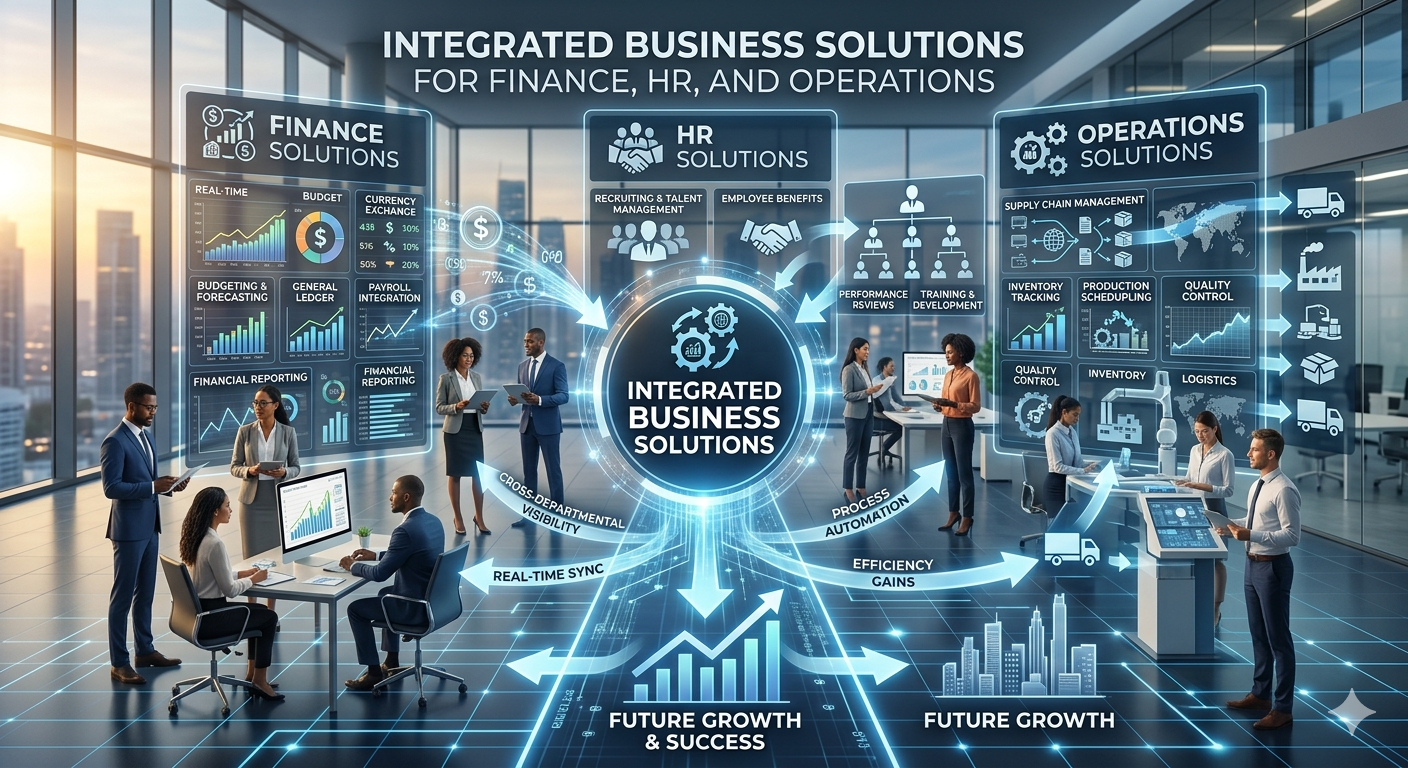
Integrated business solutions meaning refers to unified systems that link previously separate business functions, applications, and processes. Instead of operating in silos, finance, HR, operations, inventory, sales, and customer data flow seamlessly across one platform. This eliminates manual data entry, reduces errors, and provides a single source of truth for the entire organisation.
At its core, integration combines software, processes, and technologies so information moves automatically between departments. For example, when HR hires a new employee, the system can instantly update payroll in finance and resource planning in operations.
Key Benefits for Finance, HR, and Operations
Finance: Real-time reporting, automated invoicing, expense management, and compliance become far more accurate. Integrated systems reduce reconciliation time and improve cash flow forecasting.
HR: From recruitment and onboarding to payroll, performance management, and compliance, a connected platform simplifies employee lifecycle management while maintaining data security and regulatory adherence.
Operations: Inventory, supply chain, project management, and logistics gain visibility. Managers can respond faster to demand changes, optimise resources, and minimise downtime.
Overall advantages include:
- Reduced operational costs through automation.
- Improved decision-making with accurate, real-time dashboards.
- Enhanced compliance and audit readiness.
- Better employee and customer experiences.
- Scalability as the business grows.
Integrated Business Solutions Software Options
Businesses can choose from enterprise resource planning (ERP) platforms, specialised middleware, or industry-specific tools. Popular examples include Sage, Workday, Microsoft Dynamics 365 with add-ons, and dedicated integration platforms.
eOne Integrated Business Solutions specialises in connectors and integration tools, particularly for Microsoft Dynamics users, enabling smoother data flow between systems.
EDI Integrated Business Solutions focus on electronic data interchange, automating B2B document exchange (orders, invoices, shipments) with suppliers and customers for faster, error-free transactions.
Other notable providers include DTI Integrated Business Solutions, which emphasises process automation and document management, and Mahindra Integrated Business Solutions Pvt Ltd, offering advisory and business process management services, particularly strong in certain markets.
Regional Providers and Specialised Solutions
UK businesses often seek local expertise. Integrated business solutions Hampshire and integrated business solutions south providers deliver tailored implementations with on-the-ground support, understanding local regulations and business needs. These firms help with custom integrations, training, and ongoing maintenance.
How Integration Transforms Business Performance
Consider a growing retail business. Without integration, sales data might not sync with inventory, leading to stockouts or over-ordering. Finance waits days for accurate figures, and HR struggles with commission calculations. An integrated system updates everything in real time, allowing proactive management.
In manufacturing or distribution, EDI integrated business solutions streamline supply chains, reducing lead times and improving partner relationships.
Implementation Challenges and Best Practices
Common challenges include high initial costs, resistance to change, data migration risks, and choosing the wrong scope. Successful rollouts follow these steps:
- Assess current systems and pain points.
- Define clear objectives across finance, HR, and operations.
- Choose scalable, user-friendly software.
- Plan thorough data migration and testing.
- Provide comprehensive staff training.
- Monitor, measure, and optimise post-launch.
Cloud-based solutions have lowered barriers, offering subscription models that suit SMEs as well as larger enterprises.
Comparison of Integration Approaches
| Approach | Best For | Cost Level | Implementation Time | Key Advantage | Limitation |
|---|---|---|---|---|---|
| Full ERP System | Medium to large businesses | High | 6–18 months | Comprehensive coverage | Complex, expensive |
| Best-of-Breed + Middleware | Organisations with existing tools | Medium | 3–9 months | Flexibility | Multiple vendors to manage |
| Cloud-Native Integrated Platforms | Growing SMEs | Medium | 2–6 months | Fast deployment, scalability | Less customisation sometimes |
| EDI-Focused Integration | Supply chain heavy businesses | Medium | 1–4 months | B2B efficiency | Narrower functional scope |
| Industry-Specific Solutions | Sector-focused operations | Varies | Varies | Tailored compliance | Limited general applicability |
This table illustrates trade-offs when selecting integrated business solutions software.
Industry-Specific Applications
In professional services, integration links timesheets, project management, and billing. In retail and e-commerce, it connects online orders, warehouse stock, and accounting. Education and non-profits also benefit from streamlined finance and HR processes.
Integrated business solutions CA final appears in professional accounting curricula, reflecting the growing importance of understanding integrated systems for strategic business advice.
Future Trends in Integrated Business Solutions
AI-powered automation, predictive analytics, enhanced cybersecurity, and deeper ESG reporting capabilities are shaping the next generation of solutions. Businesses that integrate now position themselves to adopt these advancements more easily.
FAQ: Integrated Business Solutions
What is the integrated business solutions meaning? It describes unified platforms that connect multiple business functions like finance, HR, and operations for seamless data flow and improved efficiency.
How do integrated business solutions benefit finance, HR, and operations? They automate processes, provide real-time insights, reduce errors, ensure compliance, and enable better cross-departmental collaboration.
What is EDI integrated business solutions? EDI (Electronic Data Interchange) integration automates document exchange between trading partners, speeding up supply chain processes.
Who are eOne Integrated Business Solutions? A company specialising in integration tools and connectors, particularly for Microsoft Dynamics and similar platforms.
Are there specific integrated business solutions in Hampshire or the South? Yes, regional providers offer localised support, implementation, and ongoing services tailored to UK businesses in those areas.
What should I consider before implementing integrated business solutions software? Assess needs, budget, scalability, integration with existing tools, training requirements, and vendor support.
Do companies like DTI or Mahindra Integrated Business Solutions offer these services? Yes. DTI focuses on process automation and document management, while Mahindra provides advisory and BPM services.
Conclusion
Integrated business solutions for finance, HR, and operations deliver the connectivity modern businesses need to operate efficiently, make smarter decisions, and scale confidently. By breaking down departmental silos, these solutions turn fragmented data into a powerful strategic asset.
Whether you’re exploring basic integration or a full ERP transformation, the right approach can significantly reduce costs, improve compliance, and unlock growth potential. Evaluate your current processes, speak with specialist providers, and take the first step toward a more connected and resilient business. The organisations that thrive in the coming years will be those that integrate effectively today.