
Introduction: Why TLDR Matters in Our Fast-Paced Digital World
In today’s information-overloaded environment, attention spans are shorter than ever. Whether scrolling through Reddit threads, Twitter (now X) replies, or lengthy LinkedIn posts, people crave quick insights without committing to walls of text. This is where TLDR meaning comes into play.
What does TLDR mean?
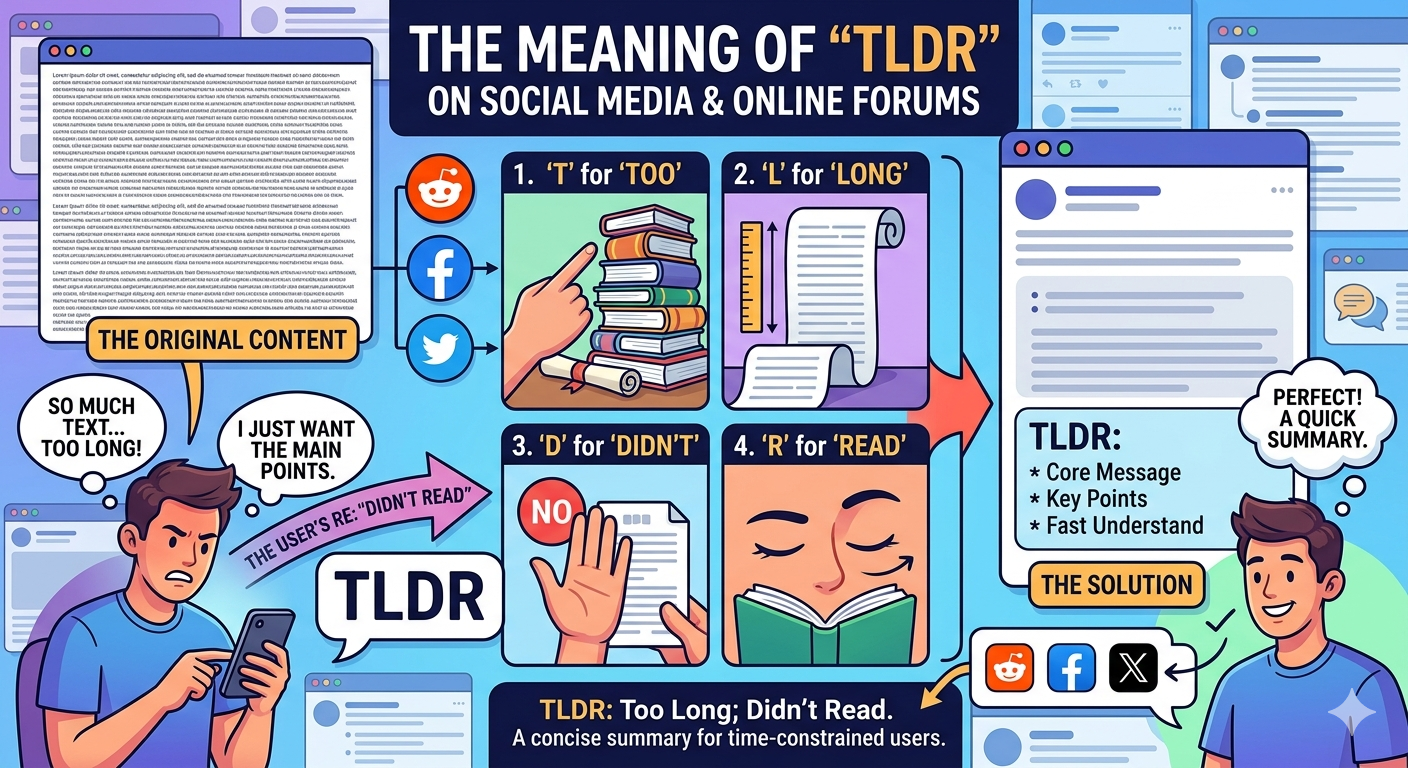
It stands for “Too Long; Didn’t Read.” This popular internet slang serves as both a cheeky dismissal and a helpful summary tool. Understanding what is TLDR and what does TLDR stand for has become essential for navigating social media, online forums, business communications, and even professional newsletters.
The TLDR meaning on social media and online forums reflects broader shifts in how we consume content. With endless feeds and notifications competing for our time, acronyms like this help filter noise and deliver value efficiently. This article dives deep into its origins, usage, evolution, related business acronyms, and modern tools like TLDR AI and TLDR newsletter services that embody the spirit of concise communication.
What Does TLDR Stand For? Origins and Evolution
What does TLDR stand for? Quite literally, “Too Long; Didn’t Read.” The semicolon in “TL;DR” adds a stylistic flair common in early internet culture, though many now write it as TLDR without punctuation.
Its roots trace back to the early 2000s on tech forums, Usenet, and message boards. One of the earliest documented uses appeared around 2002-2003 when impatient users responded to lengthy rants or detailed posts with “TLDR” to signal they skipped the content. It gained massive traction on Reddit, where long-form discussions are common, and quickly spread to other platforms.
Over time, the tone shifted. Initially dismissive or sarcastic implying the original post wasn’t worth the effort TLDR evolved into a constructive convention. Posters now proactively add a “TL;DR” section at the top or bottom of their content, providing a concise summary for time-strapped readers. Merriam-Webster even recognized it as a word in 2018, cementing its place in digital lexicon.
This evolution mirrors changes in online behavior: from flame wars in forums to curated, reader-friendly content on modern social platforms.
How TLDR Is Used on Social Media and Online Forums
On platforms like Reddit, Facebook groups, or Discord, TLDR meaning shines in practice. A user might post a detailed personal story or technical explanation followed by:
TL;DR: My flight was canceled, and the airline offered minimal compensation.
This helps others decide whether to engage fully. In comments, a standalone “TLDR” can politely (or not) request a summary or critique verbosity.
On Twitter/X or Instagram, where character limits encourage brevity, TLDR appears in threads or captions for multi-part stories. In professional settings like LinkedIn, it signals respect for colleagues’ time.
Deep insight: Effective TLDRs capture the core message, key takeaways, and sometimes a call to action without spoilers if the full post has narrative value. Poor ones oversimplify or miss nuances, which can frustrate readers seeking depth.
TLDR in Business and Professional Contexts
TLDR meaning in business has moved beyond casual slang into mainstream corporate communication. Executives and teams use it in emails, reports, and presentations to provide executive summaries. A long project update might start with “TL;DR: We hit our Q3 targets ahead of schedule.”
This practice improves efficiency in high-stakes environments where decision-makers juggle multiple priorities. However, overuse in formal documents can feel too casual context matters.
Common Related Acronyms: WFH, BRB, and More
Digital shorthand extends far beyond TLDR. Here’s a comparison of popular acronyms often searched alongside it:
| Acronym | Full Form | Common Usage | Context |
|---|---|---|---|
| TLDR / TL;DR | Too Long; Didn’t Read | Summaries in posts/emails | Social media, forums, business |
| WFH | Work From Home | Remote work arrangements | Job postings, HR discussions |
| WFM | Work From Home (variant) or Waiting For Me | Remote setups or casual chats | Slang in teams |
| BRB | Be Right Back | Temporary absence in chat | Instant messaging, gaming |
| WF | Work From (or other variants) | Shorthand in schedules | Professional slang |
| WFG | (Less common) Work For Gain / specific orgs | Varies | Niche business or medical |
The Rise of TLDR Newsletters and Tech Summaries
The demand for quick insights has spawned dedicated TLDR newsletter services. The most prominent is TLDR.tech (and its variants), founded by Dan Ni. It delivers daily curated summaries of the most important stories in tech, startups, programming, and more readable in about 5 minutes.
TLDR AI and TLDR AI newsletter focus specifically on artificial intelligence, machine learning, research papers, and breakthroughs. With hundreds of thousands of subscribers, these editions help professionals stay current without hours of scrolling. TLDR tech covers broader industry news, from AI agents to hardware advancements.
These newsletters embody what is TLDR in action: distilling complex topics into actionable bites with links for deeper dives. They often include sponsored content and community vibes, making them more engaging than raw news feeds.
Deep insight: In an AI-driven era, tools that generate TLDRs (including AI summarizers) are proliferating. While convenient, human-curated versions like TLDR.tech retain nuance and editorial judgment that pure automation might miss.
Pros, Cons, and Best Practices for Using TLDR
Advantages:
- Saves time and respects attention.
- Increases engagement readers are more likely to skim and comment.
- Improves accessibility for non-native speakers or those with cognitive load.
Potential Drawbacks:
- Can discourage deep reading or critical thinking.
- Sarcastic uses may stifle discussion.
- Oversimplification risks misinformation.
Best Practices:
- Place TLDR at the beginning for maximum impact.
- Keep it objective and spoiler-free when appropriate.
- Use in the right tone professional vs. casual.
- Combine with visuals or bullet points for scannability.
On forums, encouraging TLDR sections can elevate community quality.
TLDR AI and the Future of Summarization
TLDR AI represents the intersection of the acronym’s philosophy with cutting-edge technology. AI models now generate instant summaries of articles, videos, or meetings. While powerful, they complement rather than replace human writers especially for nuanced topics.
Future trends may include personalized TLDRs tailored to user interests or integrated into social platforms as default features.
FAQ Section
What does TLDR mean?
It stands for “Too Long; Didn’t Read” and is used for summaries or to indicate skipping long content.
What does TLDR stand for?
Too Long; Didn’t Read (sometimes stylized as TL;DR).
What is TLDR in business?
A concise summary section in reports or emails to help busy professionals grasp key points quickly.
What is the TLDR AI newsletter?
A popular daily email curating the latest AI news, research, and tools in short, digestible formats.
WFH meaning in job contexts?
Work From Home indicating remote positions or policies.
What does BRB mean?
Be Right Back, used in chats to signal a short pause.
How do TLDR newsletters like TLDR Tech work?
They curate and summarize top stories in tech/AI daily, delivered via email for quick reading.
Conclusion
The TLDR meaning on social media and online forums captures a fundamental truth about modern life: we value clarity and efficiency amid information abundance. From its humble beginnings as forum slang to powering professional communication and sophisticated newsletters like TLDR AI and TLDR tech, this acronym continues to shape how we share and consume ideas.