







Industries worldwide face mounting pressure to reduce environmental impact while maintaining productivity and profitability. From stricter emissions regulations to corporate sustainability goals and investor demands, companies must prove that their chosen technologies actually deliver promised performance. This is where environmental technology verification becomes essential.
Environmental technology verification provides independent, credible validation of a technology’s performance claims under real-world or standardised conditions. It builds trust among regulators, buyers, and stakeholders, accelerating the adoption of innovative solutions in sectors like manufacturing, energy, waste management, and water treatment. In 2026, with net-zero targets and circular economy principles gaining momentum, robust verification processes help industries de-risk investments and demonstrate genuine environmental progress.
This article examines the role of environmental technology verification in industrial applications, its benefits, key programmes, real-world examples, and implementation considerations.
What Is Environmental Technology Verification?
Environmental technology verification (ETV) is a systematic process that independently tests and confirms the performance of environmental technologies. It evaluates claims related to pollutant removal efficiency, energy consumption, emissions reduction, or resource recovery under defined conditions.
Unlike manufacturer self-declarations, ETV involves third-party testing using standardised protocols, quality assurance measures, and transparent reporting. The internationally recognised framework is ISO 14034, which provides principles and requirements for ETV.
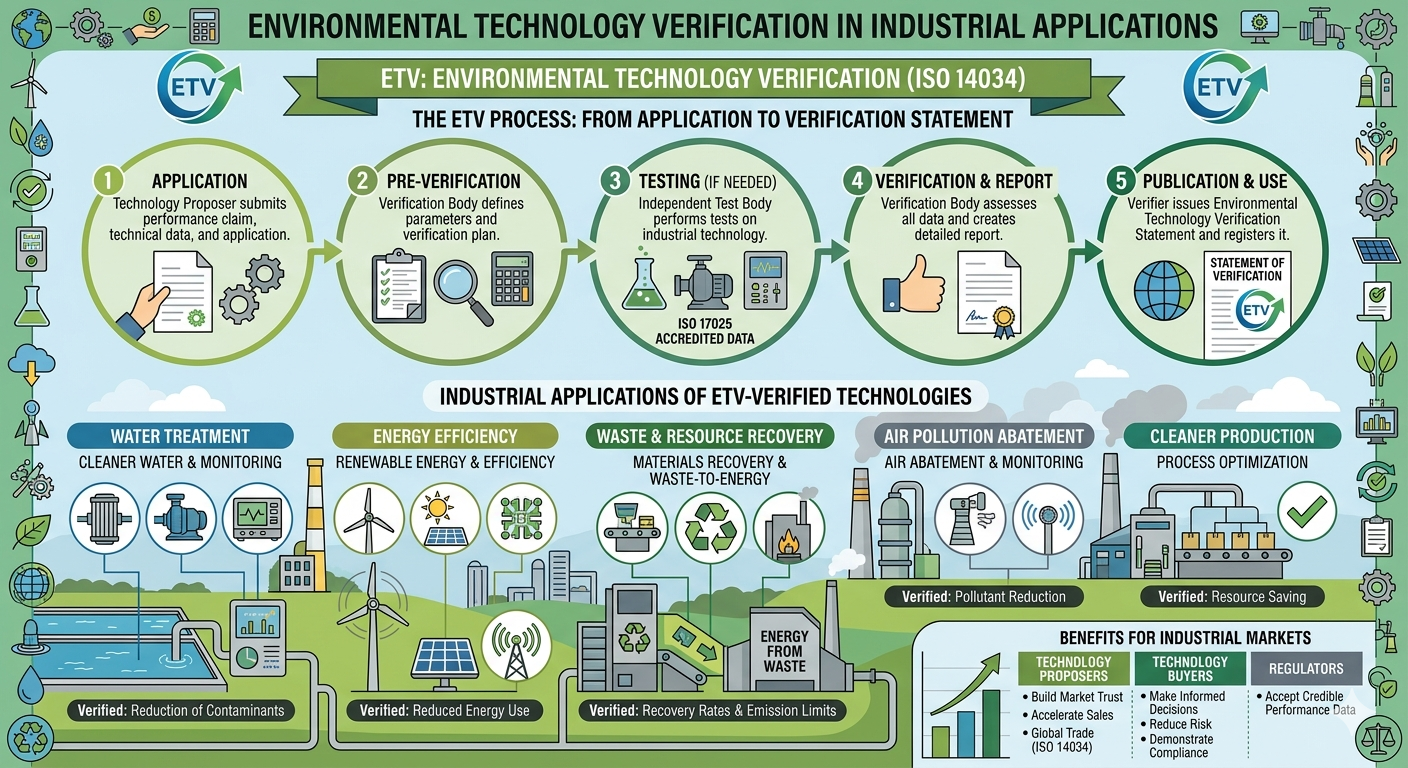
The process typically includes:
- Technology description and performance claims review.
- Test plan development.
- Independent laboratory or field testing.
- Data analysis and quality assurance.
- Issuance of a verification statement.
The Environmental Technology Verification Program
The most established initiative is the U.S. EPA’s Environmental Technology Verification Program (ETV), launched in the 1990s. Its goal is to accelerate the acceptance and use of improved, cost-effective environmental technologies by providing objective performance data.
Although the original EPA ETV pilot phase evolved, the concept continues through various verification bodies, verification centres, and ISO 14034-compliant programmes globally. In the EU, the formal ETV programme ended in 2022, but protocols remain available, and private verification bodies continue to operate. Canada and several Asian countries also maintain active ETV frameworks.
Importance in Industrial Applications
Industrial sectors generate significant environmental footprints through emissions, wastewater, waste, and energy use. Environmental technology verification helps industries in several critical ways:
Risk Reduction for Technology Adoption New technologies often carry uncertainty. Verification provides credible data, reducing financial and operational risks for industrial buyers.
Regulatory Compliance and Permitting Verified performance data can streamline permitting processes and demonstrate compliance with environmental standards.
Market Differentiation Verified technologies gain competitive advantage through credible marketing claims and easier access to green financing or procurement preferences.
Innovation Acceleration Developers receive independent feedback that helps refine products and build market confidence.
Key Industrial Applications
Air Pollution Control Verification of scrubbers, filters, catalytic converters, and VOC destruction technologies for manufacturing plants and power facilities.
Water and Wastewater Treatment Testing of advanced membranes, biological treatment systems, and zero-liquid discharge technologies used in chemical, pharmaceutical, and food processing industries.
Waste Management and Resource Recovery Verification of waste-to-energy systems, anaerobic digesters, and material recovery technologies.
Energy Efficiency and Emissions Reduction Assessment of combined heat and power (CHP) systems, industrial heat pumps, and low-emission combustion technologies.
Soil and Groundwater Remediation Verification of in-situ treatment and pump-and-treat systems for contaminated industrial sites.
Benefits for Industry Stakeholders
For Technology Developers: Independent verification strengthens market positioning and attracts investors.
For Industrial Users: Reliable performance data supports better procurement decisions and ROI calculations.
For Regulators: Objective information aids in evidence-based policy making and enforcement.
For the Environment: Faster deployment of genuinely effective technologies leads to measurable reductions in pollution and resource consumption.
Challenges in Industrial Verification
Industrial environments are complex, with variable operating conditions, feedstock quality, and integration challenges. Verification must balance scientific rigour with practical applicability. Cost and time requirements can also be barriers for smaller companies, though the long-term benefits usually outweigh initial investments.
Comparison of Verification Approaches
| Aspect | Traditional Self-Declaration | Third-Party Environmental Technology Verification | ISO 14034 ETV |
|---|---|---|---|
| Credibility | Low to Moderate | High | Very High (standardised) |
| Testing Rigour | Variable | Independent protocols | Internationally recognised |
| Cost | Low | Medium to High | Medium to High |
| Market Acceptance | Limited | Strong | Global recognition |
| Regulatory Utility | Low | High | High |
| Best For | Early-stage marketing | Industrial procurement | International markets |
This table highlights why formal environmental technology verification is preferred for serious industrial applications.
Case Studies in Industrial Settings
Waste-to-energy and biogas systems have been verified for performance in pollutant reduction and energy generation. Verified distributed generation technologies at wastewater treatment plants have demonstrated significant greenhouse gas reductions and energy cost savings.
In water treatment, verified filtration and advanced oxidation systems have helped industrial facilities meet discharge limits while reducing chemical usage.
These real-world verifications provide valuable benchmarks for similar industrial applications.
Implementation Steps for Industrial Users
- Identify performance claims relevant to your operation.
- Select a reputable verification body.
- Define test parameters that match your industrial context.
- Budget for verification as part of technology procurement.
- Use verification reports in permitting, reporting, and stakeholder communications.
Future Trends
In 2026, expect greater integration of digital twins, real-time monitoring, and AI-assisted verification. There is also growing emphasis on life-cycle assessment and circular economy metrics within verification statements. Harmonisation between different national programmes will further support global technology trade.
FAQ: Environmental Technology Verification in Industrial Applications
What is environmental technology verification?
It is an independent process that tests and confirms the performance claims of environmental technologies under defined conditions.
What is the Environmental Technology Verification Program?
Originally a U.S. EPA initiative, it provides objective performance data to accelerate the adoption of innovative environmental technologies. Similar programmes exist internationally based on ISO 14034.
Why is verification important for industrial applications?
It reduces risk, supports regulatory compliance, builds market confidence, and helps companies demonstrate genuine environmental improvements.
How long does the verification process typically take?
It varies from several months to over a year, depending on technology complexity, testing requirements, and data analysis needs.
Can small and medium enterprises benefit from ETV?
Yes. While costs are involved, verified technologies often gain faster market access, better financing terms, and stronger customer trust.
Is ETV mandatory for industrial technologies?
No, it is voluntary. However, many buyers, regulators, and investors increasingly prefer or require verified performance data.
How does verification differ from standard certification?
Verification focuses specifically on performance claims under real or simulated operating conditions, while certification often addresses safety, quality management, or design standards.
Conclusion
Environmental technology verification plays a vital role in bridging the gap between innovative environmental solutions and their successful deployment in industrial applications. By providing credible, independent performance data, it builds confidence, reduces risks, and accelerates the transition toward cleaner, more sustainable industrial operations.
For industrial operators, technology developers, and policymakers, investing in robust verification processes is a strategic decision that supports both environmental goals and business success. If you are evaluating new technologies for your facility or developing solutions for industrial markets, consider pursuing formal verification to maximise impact and adoption.