









Pursuing a degree in science laboratory technology opens doors to a practical, impactful career at the heart of scientific discovery and healthcare. As laboratories become more automated and complex, the demand for skilled technologists who can operate advanced equipment, ensure quality control, and generate reliable data continues to grow.
This degree equips students with a powerful blend of theoretical knowledge and hands-on technical expertise. Whether you aim to work in medical diagnostics, research, pharmaceuticals, environmental testing, or biotechnology, the skills developed during the programme directly translate into real-world value. In this guide, we explore the core skills you will master, career prospects, salary expectations, and options for study, including degree in science laboratory technology online pathways.
Why a Degree in Science Laboratory Technology Matters
Modern science relies heavily on accurate, reproducible laboratory work. A structured degree programme ensures graduates understand not only how to perform tests but also why specific methods matter and how to maintain safety and quality standards.
Graduates play vital roles in disease diagnosis, drug development, quality assurance, and research innovation. The combination of scientific knowledge and technical proficiency makes this qualification highly employable across multiple sectors.
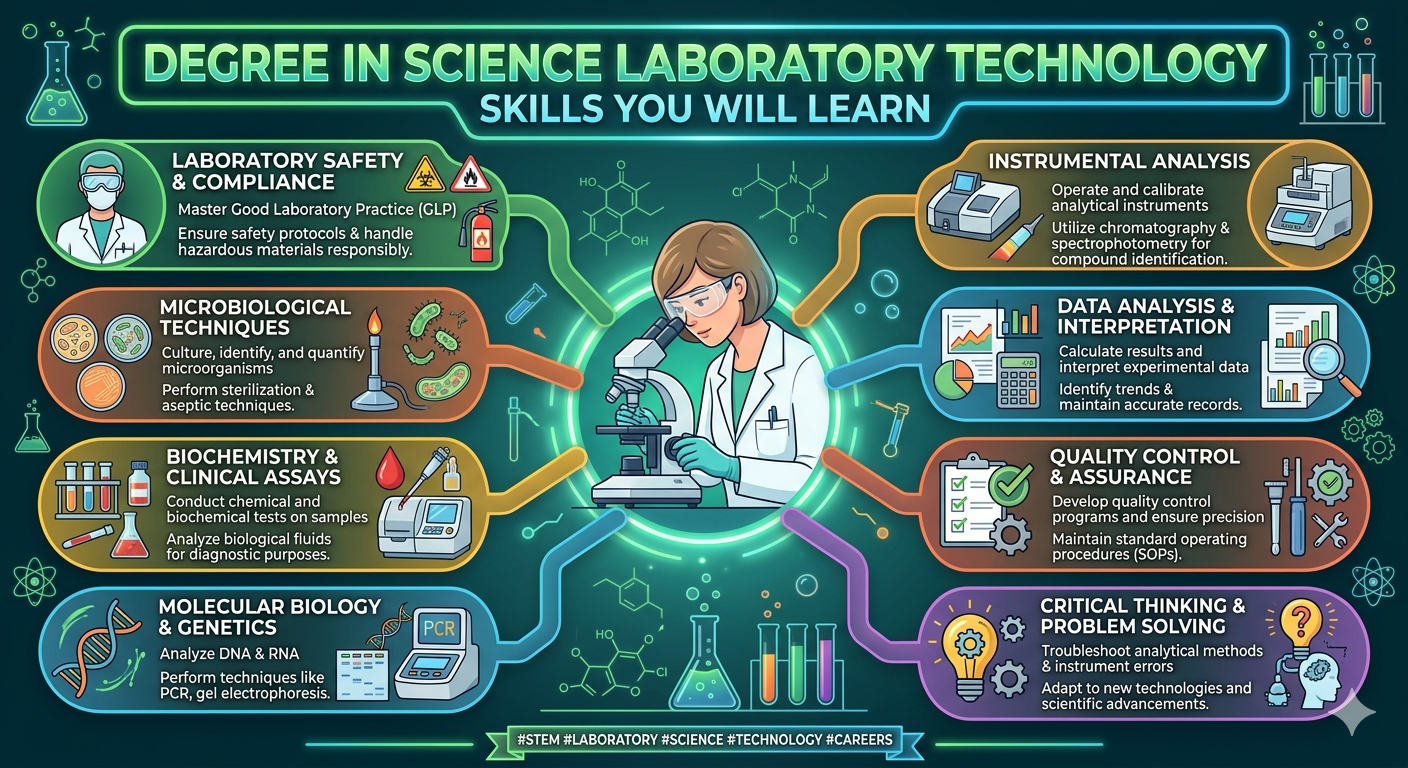
Core Skills You Will Learn
A typical degree in science laboratory technology curriculum balances foundational sciences with specialised laboratory techniques. Here are the key skills developed:
Laboratory Safety and Best Practices Students learn risk assessment, proper use of personal protective equipment (PPE), handling of hazardous materials, and emergency procedures. Biosafety levels, chemical hygiene, and regulatory compliance (such as GLP and ISO standards) are emphasised throughout the programme.
Sample Collection, Preparation, and Handling You will master aseptic techniques, accurate labelling, storage protocols, and chain-of-custody procedures. These skills are critical for preventing contamination and ensuring result integrity.
Analytical and Instrumental Techniques Programmes cover a wide range of instruments, including:
- Spectrophotometers and chromatography systems
- Microscopes and centrifuges
- PCR machines and electrophoresis equipment
- Automated analysers for clinical chemistry and haematology
Students learn calibration, maintenance, troubleshooting, and data interpretation from these tools.
Microbiology and Molecular Biology Skills Core competencies include culturing microorganisms, staining techniques, antibiotic sensitivity testing, DNA/RNA extraction, and basic molecular diagnostics. These are especially relevant for biomolecular science jobs and clinical laboratories.
Quality Control and Data Management You will study statistical quality control, validation of methods, record-keeping, and use of Laboratory Information Management Systems (LIMS). Attention to detail and documentation skills are heavily reinforced.
Soft Skills and Professionalism Effective communication, teamwork, ethical conduct, and problem-solving are integrated into the curriculum, preparing graduates for collaborative laboratory environments.
Typical Curriculum and Subjects
Most programmes include foundational and advanced modules such as:
- General Chemistry and Organic Chemistry
- Biology and Microbiology
- Anatomy and Physiology
- Clinical Biochemistry and Haematology
- Immunology and Serology
- Instrumentation and Laboratory Techniques
- Statistics and Data Analysis
- Laboratory Management and Ethics
Many programmes require a significant practical component, including internships or clinical placements, where students apply classroom knowledge in real settings.
Degree in Science Laboratory Technology Online Options
Degree in science laboratory technology online programmes have expanded, particularly for working professionals or those seeking flexibility. Many institutions offer hybrid models combining online theory with in-person practical sessions or clinical rotations.
These options suit career changers or individuals with family commitments. However, due to the hands-on nature of the field, fully online degrees are less common than blended formats, especially for clinical laboratory science tracks.
Fees and Financial Considerations
Degree in science laboratory technology fees vary by country, institution, and programme level. In the UK, undergraduate degrees typically cost £9,250 per year for domestic students. In the US, community college associate degrees can be more affordable (often $10,000–$25,000 total), while bachelor’s programmes range higher.
Scholarships, bursaries, and employer sponsorships are often available, particularly for healthcare-related tracks. Always check for additional costs such as lab fees, uniforms, and certification exams.
Laboratory Technician Apprenticeship vs Degree Route
A laboratory technician apprenticeship offers a paid, work-based alternative or complement to a full degree. Apprenticeships combine on-the-job training with academic study, often leading to Level 3 or Level 5 qualifications.
Many students begin with an apprenticeship and later top up to a full degree. The degree route generally provides broader scientific knowledge and better long-term progression opportunities, especially into senior or specialist roles.
Career Opportunities and Salary Expectations
Graduates enter diverse roles with strong demand. Common positions include laboratory technician, medical laboratory technologist, research assistant, and quality control analyst.
Degree in science laboratory technology salary expectations:
- UK: Laboratory technicians typically start at £22,000–£26,000, with experienced professionals earning £28,000–£35,000. Senior or specialist roles can exceed £40,000.
- Medical Laboratory Scientist Salary: Often higher, ranging from £30,000 to £45,000+ depending on experience and location.
Biomolecular science jobs and roles in pharmaceuticals or research frequently offer competitive packages with additional benefits.
Laboratory technician jobs are available across hospitals, universities, food testing labs, environmental agencies, and private industry.
Comparison: Degree vs Apprenticeship Pathway
| Pathway | Duration | Skills Focus | Starting Salary (UK) | Best For |
|---|---|---|---|---|
| Full Degree | 3–4 years | Broad science + advanced techniques | £24,000–£28,000 | Research, specialist, progression |
| Apprenticeship | 2–4 years | Practical, employer-specific | £18,000–£23,000 | Immediate earning + hands-on |
| Online / Blended Degree | Flexible | Theory + practical placements | Similar to full degree | Working professionals |
This comparison shows both routes have value depending on your circumstances and career goals.
Challenges and Tips for Success
The programme demands strong attention to detail, time management, and resilience during intensive practical sessions. Building a professional network through placements and professional bodies (such as the IBMS in the UK) can significantly boost career prospects.
Stay updated with emerging technologies like automation, molecular diagnostics, and data analytics to remain competitive.
FAQ: Degree in Science Laboratory Technology
What skills will I gain from a degree in science laboratory technology?
You will develop practical skills in sample analysis, instrumentation, quality control, safety protocols, data interpretation, and specialised techniques in chemistry, biology, and microbiology.
What is the typical degree in science laboratory technology salary?
In the UK, starting salaries range from £22,000–£28,000, with experienced technologists earning £30,000+ and medical laboratory scientists often higher.
Are there degree in science laboratory technology online options?
Yes, several blended and online programmes exist, though most require some in-person practical or clinical components.
How does a degree compare to a laboratory technician apprenticeship?
A degree offers broader scientific knowledge and better progression, while apprenticeships provide paid experience and quicker workforce entry.
What jobs can I get after completing the degree?
Common roles include laboratory technician, medical laboratory technologist, quality control analyst, and research assistant across healthcare, industry, and research sectors.
What are typical degree in science laboratory technology fees?
Costs vary by location, but UK undergraduate fees are around £9,250 per year. Additional lab and material fees may apply.
Are biomolecular science jobs accessible with this degree?
Yes. The molecular biology and biotechnology components prepare graduates well for roles in genomics, drug development, and related fields.
Conclusion
A degree in science laboratory technology delivers a robust, practical education that equips you with valuable technical and scientific skills highly sought after in today’s job market. From mastering complex instrumentation to ensuring laboratory quality and safety, the programme prepares you for a stable, rewarding career with strong growth potential.
If you enjoy hands-on science and contributing to meaningful outcomes in healthcare or research, this path is worth serious consideration. Explore available programmes, compare degree in science laboratory technology online options with traditional or apprenticeship routes, and take the first step toward a fulfilling laboratory career.