








Many entrepreneurs searching for what is an LLC UK quickly discover a key distinction: the UK does not have a direct equivalent to the American Limited Liability Company (LLC). This difference often leads to confusion when comparing business structures across borders. Understanding what is an LLC and how it operates in the US versus the closest UK options is essential for anyone planning a business, especially those targeting international markets or cross-border operations.
This article provides a clear, in-depth comparison to help you decide the best structure for your needs. We’ll explore what is an LLC company, what is an LLC and how does it work, what is an LLC in America, and the practical realities of setting up in the UK.
What Is an LLC? Understanding the Basics
What is an LLC in the USA starts with its hybrid nature. A Limited Liability Company combines the liability protection of a corporation with the tax flexibility and simplicity of a partnership. Created at the state level, an LLC shields owners’ (members’) personal assets from business debts and lawsuits while allowing profits to “pass through” to personal tax returns by default.
What is an LLC business like in practice? Owners can manage it themselves or appoint managers. It offers flexible profit-sharing and fewer formalities than corporations. This makes it popular for small businesses, freelancers, and real estate investors in the US.
What is an LLC in America typically involves filing articles of organization with a state (e.g., Delaware or Wyoming for privacy and low fees), paying a filing fee, and creating an operating agreement. No minimum capital is usually required, and annual compliance varies by state.
What Is an LLC UK? The UK Equivalent Explained
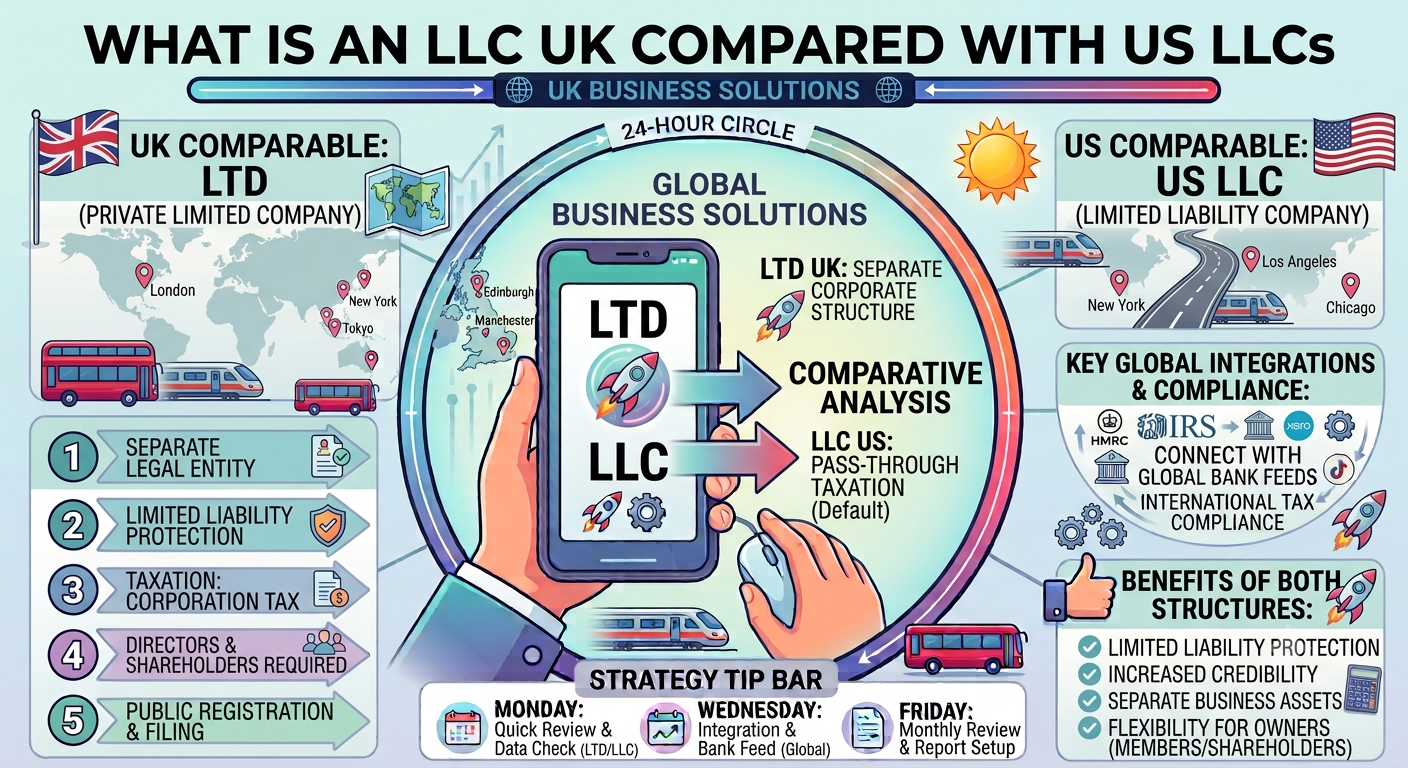
What is an LLC UK has a straightforward answer: there is no such legal entity. UK company law does not recognize LLCs. The closest and most common equivalent is a Private Limited Company (Ltd), registered with Companies House under the Companies Act 2006.
A UK Ltd is a separate legal entity with limited liability for shareholders. Directors manage operations, and liability is generally limited to the value of shares issued (often just £1). This structure provides strong credibility, especially in the UK and EU.
Another option is a Limited Liability Partnership (LLP), more common for professional services like law or accounting firms, offering partnership flexibility with limited liability.
What is an LLC in the UK searches usually point people toward forming a Ltd company because it delivers similar protections and professionalism.
Key Differences: US LLC vs UK Ltd
The structures share limited liability but diverge significantly in taxation, formation, compliance, and suitability.
Formation and Setup
- US LLC: Formed quickly in chosen states. Costs vary ($50–$500+), often requiring a registered agent. Non-residents can own them fully.
- UK Ltd: Registered online with Companies House for as little as £12–£100. A UK registered office address is needed (virtual options available). Extremely fast—often same-day.
Taxation
This is where differences are most pronounced:
- US LLC (default): Pass-through taxation. Profits flow to members’ personal returns. For non-US residents with no US-source income or effectively connected income (ECI), US federal tax may be minimal or zero. However, self-employment taxes or state rules can apply.
- UK Ltd: Pays UK Corporation Tax (19% small profits rate up to £50,000, marginal relief, up to 25% main rate). Dividends to shareholders are taxed personally after an allowance, creating a two-tier system.
UK residents owning US LLCs face complex “reverse hybrid” issues where HMRC may treat the LLC as opaque (corporation-like), potentially leading to double taxation risks without proper planning.
Compliance and Ongoing Costs
- US LLC: Annual reports and fees vary by state (e.g., low in Wyoming). Foreign-owned single-member LLCs often need Form 5472, with high penalties for non-compliance.
- UK Ltd: Annual Confirmation Statement (£13), accounts filing, and Corporation Tax returns. Predictable but requires transparency via public registers (e.g., Persons with Significant Control).
Limited Liability Protection
Both offer strong protection, but maintaining it requires separating personal and business finances, proper records, and avoiding personal guarantees.
Comparison Table: US LLC vs UK Ltd
| Aspect | US LLC | UK Ltd (Private Limited Company) |
|---|---|---|
| Legal Status | Hybrid (partnership/corporation flexible) | Separate legal entity |
| Formation Cost | $50–$500+ (state-dependent) | £12–£100 |
| Taxation (Default) | Pass-through to owners | Corporation Tax + personal dividend tax |
| Ownership | Flexible members/managers | Shareholders and directors |
| Compliance | State-specific, variable | Standardized annual filings with Companies House |
| Best For | US-focused operations, flexibility | UK/EU credibility, simpler international treaties |
| Non-Resident Friendly | Yes, with tax considerations | Yes, straightforward |
Deep Insights: Choosing Between Structures for Your Business
For UK residents or those targeting Europe, a UK Ltd often makes more sense due to familiarity, easier banking, VAT compliance, and access to incentives like SEIS/EIS for investors. It provides clear corporate tax treatment and strong global perception in many markets.
US LLCs appeal for businesses heavily involved in the American market, offering better access to US payment processors (e.g., Stripe US), banking, and investor preferences in some cases. However, cross-border tax mismatches require expert advice to avoid pitfalls like dual taxation.
What is an LLC and how does it work in a global context often means weighing these trade-offs. Many international founders use both: a UK Ltd for European operations and a US LLC for US activities, though this increases complexity and costs.
Consider your target market, customer base, funding plans, and long-term exit strategy. Consulting a cross-border accountant or lawyer is highly recommended, as rules evolve (e.g., ongoing HMRC consultations on LLC taxation).
Practical Considerations for Entrepreneurs
- Banking and Payments: UK Ltd integrates easily with UK banks; US LLCs may open doors to US-focused fintech.
- Raising Capital: US investors often prefer Delaware C-Corps over LLCs, while UK structures suit European funding.
- Scalability: Both can grow, but UK Ltd has straightforward share issuance for expansion.
- Dissolution: LLCs can be relatively simple to wind up; UK companies follow statutory procedures.
FAQ: Answering Common Questions
What is an LLC UK?
There is no official LLC in the UK. The equivalent is typically a Private Limited Company (Ltd), which offers limited liability and separate legal status.
What is an LLC in the USA compared to the UK?
A US LLC provides pass-through taxation and flexibility, while a UK Ltd involves corporate taxation and more formal governance suited to UK regulations.
What is an LLC company and how does it work in America?
It protects personal assets and passes profits to owners’ taxes. Members file based on ownership percentage unless electing corporate taxation.
Can a UK resident form a US LLC?
Yes, but expect complex UK tax reporting and potential classification differences with HMRC. Professional advice is essential.
What is an LLC business best suited for?
Small to medium operations seeking simplicity and protection, especially in the US market.
What is an LLC in the UK for tax purposes?
UK authorities treat foreign LLCs based on their characteristics, often as opaque entities, affecting how profits are taxed for UK residents.
Should I form a UK Ltd or US LLC for international business?
It depends on your primary market. UK Ltd for Europe/UK focus; US LLC for strong US presence. Many use both strategically.
Conclusion: Make an Informed Choice for Your Business Future
Understanding what is an LLC UK reveals it’s not a direct match for the US version but that UK Ltd companies provide a robust, credible alternative tailored to British and European needs. The comparison highlights trade-offs in flexibility, taxation, compliance, and market access.