







Navigating UK roads safely requires understanding various traffic signs and junctions. Among the most common yet sometimes confusing are those related to roundabouts, particularly the mini roundabout sign. For learner drivers, new residents, or anyone refreshing their knowledge, mastering the mini roundabout sign and how to use it correctly can prevent hesitation, reduce accidents, and build driving confidence.
This article explains the mini roundabout sign UK, its differences from standard roundabout signs, practical navigation tips, and key rules from the Highway Code. Whether you’re preparing for your driving test or simply want clearer roads, proper knowledge of roundabout vs mini roundabout sign improves flow and safety.
What Is a Mini Roundabout Sign?
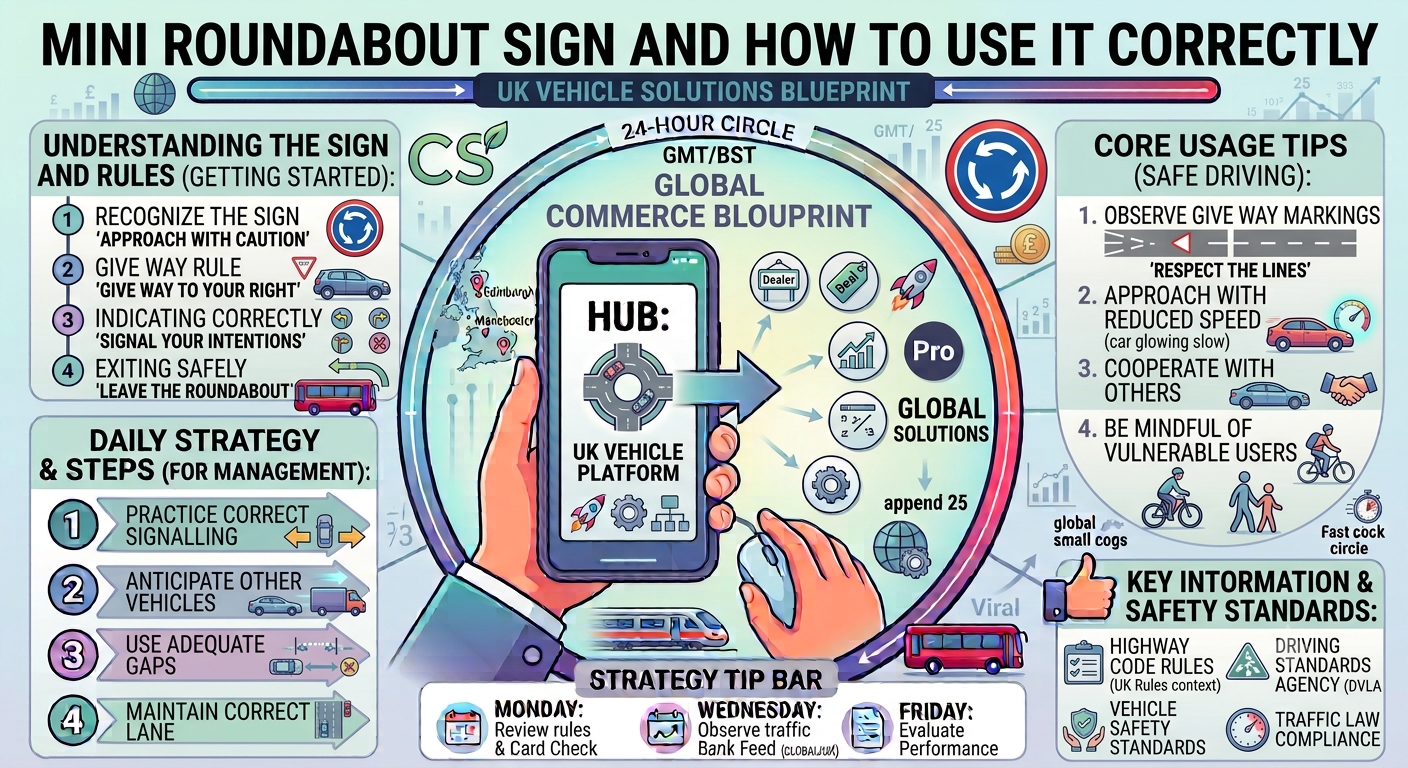
The mini roundabout sign is a blue circular sign featuring three white arrows circulating clockwise. It indicates an upcoming mini-roundabout and instructs drivers to give way to traffic approaching from the right. This sign is unique to mini-roundabouts and not used for larger junctions.
Unlike warning signs for bigger roundabouts (often a red triangle with a roundabout symbol), the blue mini roundabout sign provides a mandatory instruction. It is usually placed close to the junction, sometimes paired with give-way markings on the road.
Mini-roundabouts are compact junctions, common in residential areas, busy T-junctions, or space-constrained spots. They feature a painted white circle (or slightly raised dome) in the center, typically 1-4 meters in diameter, which larger vehicles may need to drive over.
Roundabout Sign and Mini Roundabout Sign: Key Differences
Understanding the difference between roundabout and mini roundabout sign is crucial for correct decision-making.
| Aspect | Standard Roundabout Sign | Mini Roundabout Sign |
|---|---|---|
| Shape & Color | Red triangle (warning) with roundabout symbol | Blue circle with white clockwise arrows (instruction) |
| Placement | Further in advance | Closer to the junction |
| Junction Size | Larger, often multi-lane with islands | Small, painted central circle/dome, fully traversable |
| Approach | More time to position and signal | Limited space and time; treat cautiously |
| Central Feature | Raised island (non-mountable) | Mountable painted circle for larger vehicles |
| Common Locations | Major roads, high-traffic areas | Residential streets, urban calming measures |
Roundabout vs mini roundabout sign highlights design intent: larger roundabouts manage high-speed or high-volume traffic, while mini versions calm traffic in tighter spaces. The roundabout sign and mini roundabout sign both enforce giving way to the right, but the physical layout demands different techniques.
Mini roundabout sign vs roundabout sign confusion often arises for learners. The blue sign specifically signals a mini-roundabout, requiring drivers to anticipate less maneuvering room.
Highway Code Rules for Mini Roundabouts
The UK Highway Code provides clear guidance. Rule 188 states: Approach mini-roundabouts in the same way as normal roundabouts. All vehicles must pass round the central markings except large vehicles physically incapable of doing so. There is less space to manoeuvre and less time to signal. Avoid U-turns and watch for others attempting them.
For double mini-roundabouts, treat each separately and give way to traffic from the right at each one.
Key principles:
- Give way to traffic already on the roundabout and approaching from the right.
- Signal clearly and in good time where possible.
- Proceed only when safe.
How to Use the Mini Roundabout Sign Correctly: Step-by-Step Approach
Approaching a mini roundabout sign requires the Mirror-Signal-Position-Speed-Look (MSPSL) routine, adapted for the compact size.
1. On Approach
- Spot the blue mini roundabout sign early.
- Check mirrors (interior and right).
- Decide your exit and signal accordingly: left for first exit, right for right turn or full circle (keep signal on until exiting), no signal for straight ahead in many cases, but confirm with observation.
- Slow down and select the correct gear for low-speed control.
2. At the Give-Way Line
- Stop if necessary and give way to traffic from the right.
- Look right, ahead, and left as needed. Assess pedestrian and cyclist movements.
- Enter when safe, keeping to the left of the central markings.
3. Negotiating the Junction
- Steer smoothly around the center.
- Maintain awareness of other users mini-roundabouts have less time for reactions.
- For larger vehicles: The Highway Code allows driving over the central dome if necessary.
4. Exiting
- Signal left before leaving if not already indicating.
- Check mirrors, especially the left for cyclists.
- Accelerate smoothly into the new road.
Deep Insight: Mini-roundabouts promote traffic flow by removing full stops at crossroads, but their small size increases vulnerability to poor observation. Drivers who hesitate or fail to signal create uncertainty, leading to near-misses. Mastering this builds smoother urban driving habits.
Common Mistakes and How to Avoid Them
- Treating it like a crossroads: Always prioritize right-hand traffic.
- Poor signaling: Limited space means early, clear signals matter more.
- Driving over the center unnecessarily: Cars should circulate around it when possible.
- U-turns: Generally discouraged due to tight space.
- Ignoring cyclists/pedestrians: Mini-roundabouts often appear in shared spaces.
For mini roundabout sign UK contexts, local variations exist, but Highway Code rules are universal.
Benefits of Mini Roundabouts
These junctions reduce speeds, lower accident severity, and improve capacity compared to signalized or stop-controlled intersections. They are cost-effective traffic-calming tools widely used in the UK.
FAQ: Mini Roundabout Sign Questions Answered
1. What does the mini roundabout sign look like?
It is a blue circle with three white arrows pointing clockwise, indicating circulation and give-way to the right.
2. What’s the difference between roundabout and mini roundabout sign?
The standard roundabout sign is usually a red triangular warning, while the mini version is a blue instructional circle specifically for small junctions.
3. Do I have to stop at every mini roundabout?
No give way only when traffic approaches from the right. Proceed if clear.
4. Can large vehicles drive over the center?
Yes, the Highway Code permits it if they cannot physically go around.
5. How do I signal at a mini roundabout?
Use the same rules as larger roundabouts: left for left turn, right for right, none (or adjust) for straight on. Signal early where safe.
6. Is the mini roundabout sign different in other countries?
Rules and signs vary internationally, but in the UK it follows specific TSRGD standards.
7. What if I’m unsure about a junction?
Slow down, observe carefully, and prioritize safety over hesitation. Practice with an instructor.
Conclusion
The mini roundabout sign is a vital part of safe UK driving. By understanding roundabout and mini roundabout sign distinctions, mini roundabout sign vs roundabout sign, and correct usage, drivers navigate these junctions confidently and contribute to safer roads.