 11
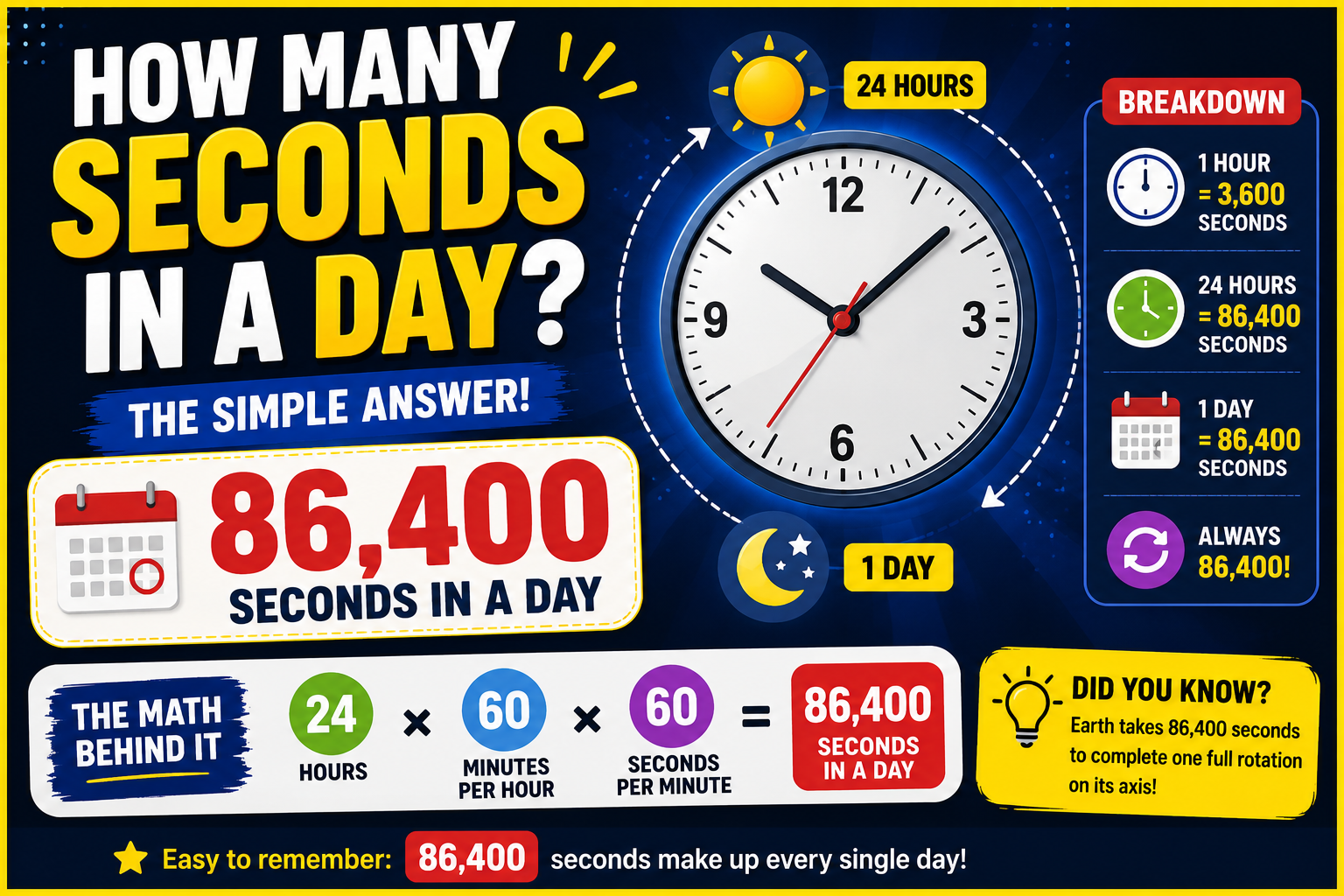
Time is something we use every day, yet many people wonder exactly how many seconds in a day. Whether you’re solving a math problem, writing code, studying science, or simply curious, knowing this basic time conversion can be surprisingly useful.
The answer is simple:
There are 86,400 seconds in a standard 24-hour day.
In this guide, you’ll learn how this number is calculated, why it matters, common time conversions, and answers to frequently asked questions.
A standard day consists of:
The calculation is straightforward:
| Time Unit | Value |
|---|---|
| Hours in a day | 24 |
| Minutes in an hour | 60 |
| Seconds in a minute | 60 |
| Total seconds in a day | 86,400 |
24 × 60 × 60 = 86,400 secondsSo, a normal day contains 86,400 seconds.
Let’s break it down.
24 × 60 = 1,440 minutes1,440 × 60 = 86,400 secondsThat’s how we arrive at the final answer.
The modern system of measuring time comes from ancient civilizations that divided hours into 60 minutes and minutes into 60 seconds. Since there are 24 hours in a day, multiplying these units together gives us:
24 × 60 × 60 = 86,400This standard is used worldwide in science, technology, engineering, and everyday life.
Here’s a quick reference for common time conversions.
| Time Unit | Equivalent |
|---|---|
| 1 minute | 60 seconds |
| 5 minutes | 300 seconds |
| 10 minutes | 600 seconds |
| 30 minutes | 1,800 seconds |
| 1 hour | 3,600 seconds |
| 12 hours | 43,200 seconds |
| 24 hours (1 day) | 86,400 seconds |
| 7 days (1 week) | 604,800 seconds |
Understanding time conversions has practical applications in many fields.
Software developers often work with timestamps measured in seconds.
For example:
Many school assignments involve converting between:
Knowing the basic formulas makes these calculations much easier.
Scientists frequently measure experiments using seconds because they provide a precise unit of time.
Workout apps, smartwatches, and sports trackers often record exercise duration in seconds.
Businesses sometimes estimate machine runtime, production schedules, or system uptime using seconds.
Here are a few additional conversions.
| Time Period | Seconds |
|---|---|
| 1 minute | 60 |
| 1 hour | 3,600 |
| 1 day | 86,400 |
| 2 days | 172,800 |
| 3 days | 259,200 |
| 1 week | 604,800 |
| 30 days | 2,592,000 |
| 365 days | 31,536,000 |
Note: A leap year has 31,622,400 seconds because it contains 366 days.
You can calculate seconds using this simple formula:
Seconds = Hours × 60 × 60Or:
Seconds = Minutes × 60Examples:
A standard day has 86,400 seconds.
Multiply the number of hours by the number of minutes per hour and the number of seconds per minute:
24 × 60 × 60 = 86,400
There are 1,440 minutes in one day.
12 × 60 × 60 = 43,200 seconds.
A week contains 604,800 seconds.
Yes. Since a leap year has 366 days, it contains 31,622,400 seconds.
The answer to how many seconds in a day is 86,400. This comes from multiplying 24 hours × 60 minutes × 60 seconds. While it’s a simple calculation, it’s an important conversion used in mathematics, programming, science, engineering, and everyday life.
If you frequently work with time conversions, remembering that one day equals 86,400 seconds can save time and make calculations much easier.