




In today’s rapidly evolving business landscape, organizations face unprecedented challenges from technological disruption, global competition, and shifting workforce expectations. A robust leadership development strategy is no longer optional it’s essential for building resilient teams and sustainable success. This comprehensive approach to leadership development equips emerging and current leaders with the skills, mindset, and adaptability needed to navigate complexity and drive innovation.
Future business leaders must go beyond traditional management tactics. They need to inspire purpose-driven cultures, leverage AI ethically, foster inclusivity, and make decisions amid uncertainty. Investing in a targeted leadership development strategy helps companies retain top talent, boost engagement, and maintain a competitive edge. This article explores proven frameworks, emerging trends, practical implementation steps, and real-world insights to help organizations and aspiring leaders thrive.
What Is a Leadership Development Strategy?
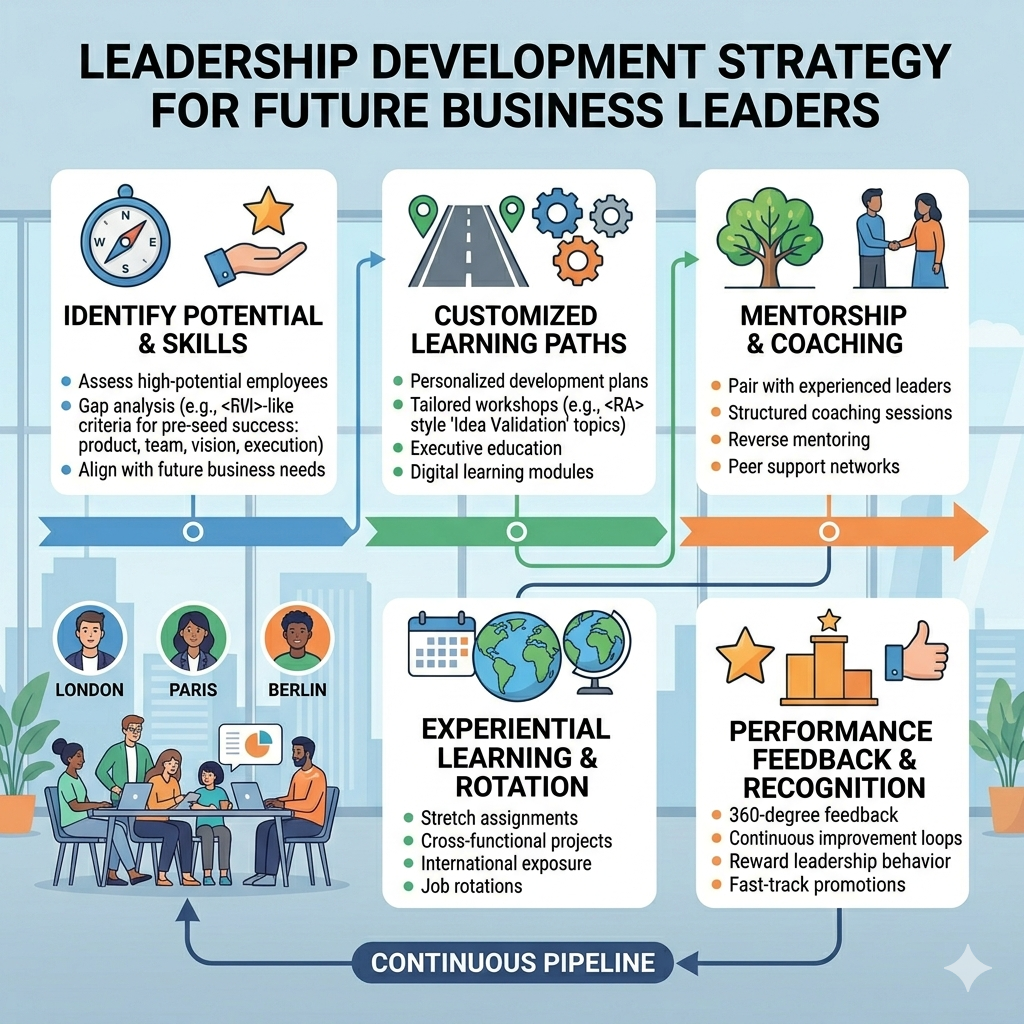
A leadership development strategy is a long-term, systematic plan to identify, nurture, and elevate leadership capabilities across all organizational levels. It aligns individual growth with business objectives, focusing on closing skill gaps and preparing leaders for future demands.
Unlike one-off training sessions, an effective strategy integrates assessment, experiential learning, coaching, and ongoing evaluation. It addresses leadership development programs, leadership development training, leadership development coaching, and leadership development courses in a cohesive manner.
Key distinctions include:
- Leadership development programmes (often used in international contexts) emphasize structured, multi-month journeys.
- Leadership development companies provide specialized external expertise and customized solutions.
This strategic focus differentiates high-performing organizations that treat leadership as a core competency rather than a peripheral HR function.
Why Leadership Development Matters for Future Business Success
The business case is compelling. Companies with strong leadership development pipelines report higher employee engagement, better retention, and superior financial performance. In an era of AI adoption and hybrid work, leaders who lack adaptability risk obsolescence.
Future leaders must master human-centered skills alongside technical proficiency. Trends show that empathy, relational intelligence, and continuous learning are becoming differentiators. Organizations investing in leadership development strategy build succession pipelines that reduce recruitment costs and ensure cultural continuity.
Moreover, effective leadership development training correlates with innovation and agility. Leaders equipped to handle change can pivot faster during market disruptions, turning challenges into opportunities.
Key Components of an Effective Leadership Development Strategy
Successful strategies share common building blocks. Here are the foundational elements:
1. Alignment with Business Objectives
Every strong leadership development strategy starts with a deep understanding of organizational goals. Leaders identify required competencies such as strategic thinking, digital fluency, and change management that directly support revenue growth, innovation, or market expansion.
2. Comprehensive Assessment and Gap Analysis
Use 360-degree feedback, psychometric tools, and performance data to evaluate current capabilities. This step reveals strengths and development areas for high-potential talent.
3. Blended Learning Approaches
Modern leadership development programs combine:
- Classroom or virtual workshops
- On-the-job experiences and stretch assignments
- Leadership development coaching for personalized guidance
- Digital leadership development courses for flexible, self-paced learning
Blended models prove more effective than traditional lectures.
4. Experiential and Real-World Application
Growth accelerates when learning connects to actual business challenges. Rotational assignments, cross-functional projects, and mentorship programs provide practical exposure.
5. Measurement and Continuous Improvement
Track metrics like promotion rates, employee engagement scores, and business impact. Regular reviews ensure the strategy evolves with needs.
6. Executive Buy-In and Cultural Support
Visible sponsorship from senior leaders signals importance and encourages participation. A learning culture normalizes feedback and development.
Emerging Trends in Leadership Development for 2026 and Beyond
The landscape is shifting rapidly. Key trends shaping leadership development strategy include:
- Human-Centered Leadership: Prioritizing well-being, empathy, and relational intelligence amid AI advancements.
- AI Integration: Tools for personalized coaching, skill assessments, and adaptive learning paths.
- Agility and Change Mastery: Leaders must thrive in flatter, hybrid structures while managing uncertainty.
- Continuous Upskilling: Lifelong learning embedded in daily work rather than isolated events.
- Inclusivity and Equity: Programs designed to develop diverse leadership talent.
These trends underscore the need for flexible, technology-enhanced leadership development programmes that prepare leaders for hybrid and distributed environments.
Building a Leadership Development Strategy: Step-by-Step Guide
Creating or refining your approach involves these practical steps:
- Define Business Priorities: Align with strategic goals through leadership workshops.
- Identify Competencies: Pinpoint skills like emotional intelligence, innovation, and ethical decision-making.
- Assess Talent: Evaluate current and potential leaders.
- Design Customized Experiences: Blend leadership development training, coaching, and experiential learning.
- Implement with Support: Secure resources and executive involvement.
- Measure Results: Use KPIs and adjust iteratively.
Leadership development companies can accelerate this process by bringing external benchmarks and expertise.
Leadership Development Programs, Courses, and Coaching Options
A variety of solutions exist to support your strategy:
- In-House Programs: Tailored to company culture and challenges.
- External Leadership Development Courses: Offered by top providers like Center for Creative Leadership (CCL), Wharton, or specialized firms.
- Leadership Development Coaching: One-on-one guidance for high-potentials.
- Rotational and Experiential Programs: Common in large corporations for broad exposure.
Many organizations combine internal and external options for optimal results.
Comparison of Popular Leadership Development Approaches
| Approach | Best For | Key Benefits | Potential Drawbacks | Examples |
|---|---|---|---|---|
| Blended Learning Programs | Mid-to-senior leaders | Flexibility, real-world application | Higher cost if not scaled | CCL programs, custom corporate tracks |
| Executive Coaching | High-potentials & executives | Personalized, measurable growth | Time-intensive | One-on-one sessions with certified coaches |
| Online Leadership Courses | Emerging leaders, busy professionals | Accessible, self-paced | Less interaction | Platforms like Coursera, LinkedIn Learning |
| Rotational Assignments | Future business leaders | Broad exposure, networking | Disruptive to current roles | Corporate leadership development programs (e.g., J&J, Fortune 500 firms) |
| Mentorship & Peer Networks | All levels | Knowledge sharing, support | Variable quality | Internal programs or EO/YPO networks |
This table highlights how different elements complement each other within a comprehensive leadership development strategy.
Challenges in Implementing Leadership Development and How to Overcome Them
Common obstacles include limited budgets, resistance to change, and difficulty measuring ROI. Solutions involve starting small with pilot programs, demonstrating quick wins, and tying initiatives directly to business outcomes. Partnering with reputable leadership development companies can provide proven frameworks and external accountability.
Another challenge is sustaining momentum. Embed development into performance reviews and career paths to make it ongoing rather than episodic.
Leadership Development Jobs and Career Opportunities
The field itself offers exciting paths. Roles in leadership development jobs include Learning & Development specialists, Talent Management directors, Executive Coaches, and OD (Organization Development) consultants. Demand is growing as companies prioritize people strategies. Skills in program design, facilitation, and data analytics are highly valued.
Aspiring professionals can enter through HR, consulting, or internal progression after gaining business experience.
Case Studies and Real-World Insights
Organizations like those partnering with CCL or implementing blended models report stronger pipelines and higher innovation rates. For instance, companies focusing on human-centered leadership see improved retention in competitive talent markets.
Smaller firms can achieve similar results by leveraging affordable leadership development courses and internal mentorship.
FAQ: Common Questions About Leadership Development Strategy
What is the difference between leadership development and management training?
Leadership development focuses on vision, inspiration, and strategic influence, while management training emphasizes operational efficiency and day-to-day execution.
How long does it take to see results from a leadership development program?
Visible improvements in individual skills can appear within months, but organizational impact such as better succession and performance often takes 1-3 years of sustained effort.
Are leadership development courses worth the investment?
Yes, when aligned with business needs. Look for programs with strong experiential components and measurable outcomes.
How can small businesses implement a leadership development strategy?
Start with targeted coaching, peer learning circles, and free or low-cost online courses. Focus on high-impact areas like communication and decision-making.
What role does coaching play in leadership development?
Leadership development coaching accelerates growth through personalized feedback and accountability, making it highly effective for senior or high-potential leaders.
How do I measure the success of leadership development initiatives?
Track metrics like promotion rates, 360-feedback improvements, employee engagement scores, and business KPIs influenced by leaders.
What are the top skills for future business leaders?
Emotional intelligence, adaptability, AI literacy, strategic thinking, and inclusivity.
Conclusion: Investing in Tomorrow’s Leaders Today
A well-crafted leadership development strategy is a powerful lever for organizational resilience and growth. By embracing leadership development training, programs, coaching, and continuous learning, companies prepare future business leaders to handle complexity with confidence and humanity.
Whether you’re an HR leader designing programs, a manager investing in your growth, or an executive shaping strategy, the time to act is now. Assess your current approach, align it with future needs, and commit to building leaders who don’t just manage change they drive it.