









Time is something we use every day, yet many people wonder exactly how many seconds in a day. Whether you’re solving a math problem, writing code, studying science, or simply curious, knowing this basic time conversion can be surprisingly useful.
The answer is simple:
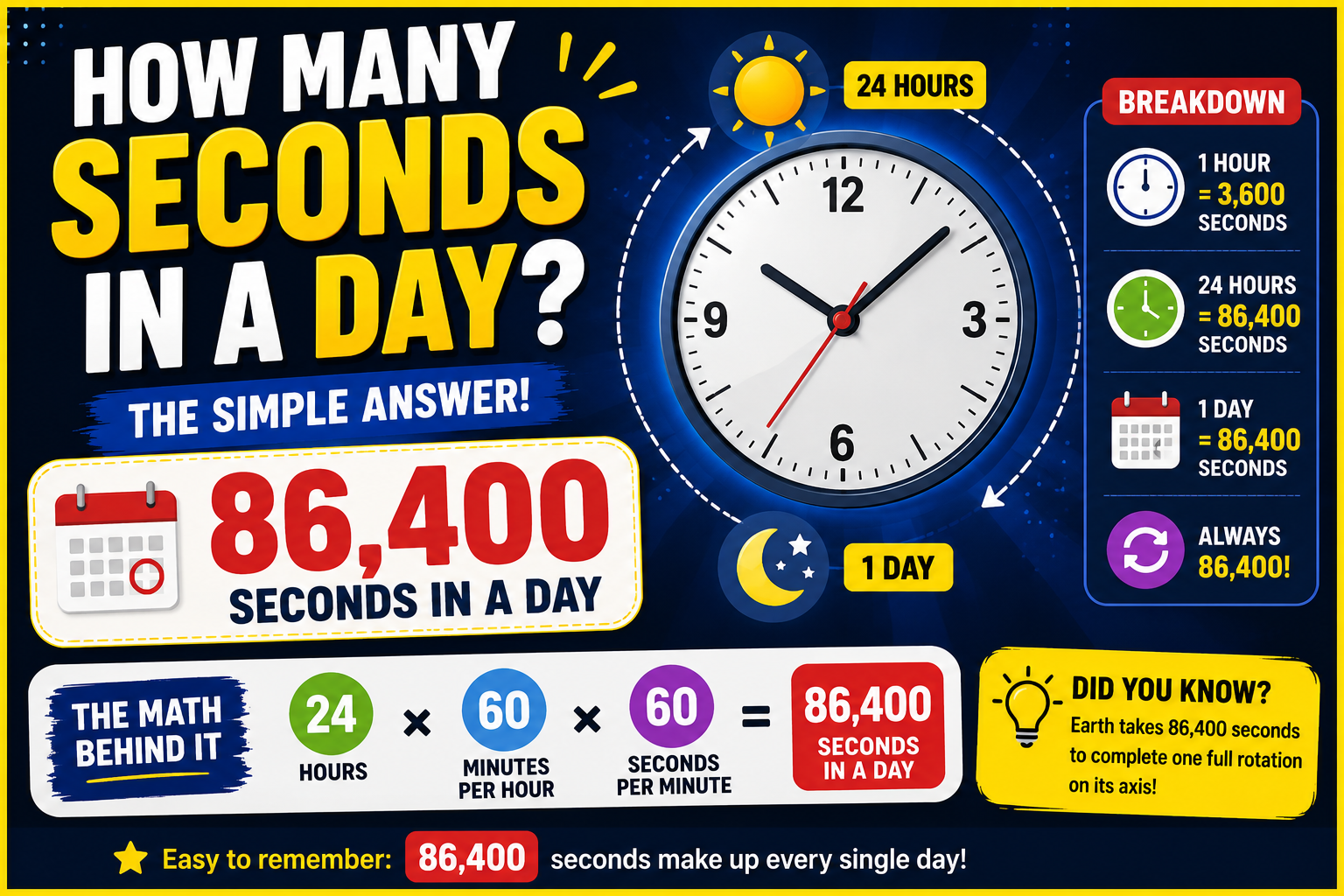
There are 86,400 seconds in a standard 24-hour day.
In this guide, you’ll learn how this number is calculated, why it matters, common time conversions, and answers to frequently asked questions.
How Many Seconds in a Day?
A standard day consists of:
- 24 hours
- 1,440 minutes
- 86,400 seconds
The calculation is straightforward:
| Time Unit | Value |
|---|---|
| Hours in a day | 24 |
| Minutes in an hour | 60 |
| Seconds in a minute | 60 |
| Total seconds in a day | 86,400 |
Formula
24 × 60 × 60 = 86,400 secondsSo, a normal day contains 86,400 seconds.
Step-by-Step Calculation
Let’s break it down.
Step 1: Hours to Minutes
24 × 60 = 1,440 minutesStep 2: Minutes to Seconds
1,440 × 60 = 86,400 secondsThat’s how we arrive at the final answer.
Why Is It 86,400 Seconds?
The modern system of measuring time comes from ancient civilizations that divided hours into 60 minutes and minutes into 60 seconds. Since there are 24 hours in a day, multiplying these units together gives us:
24 × 60 × 60 = 86,400This standard is used worldwide in science, technology, engineering, and everyday life.
Time Conversion Table
Here’s a quick reference for common time conversions.
| Time Unit | Equivalent |
|---|---|
| 1 minute | 60 seconds |
| 5 minutes | 300 seconds |
| 10 minutes | 600 seconds |
| 30 minutes | 1,800 seconds |
| 1 hour | 3,600 seconds |
| 12 hours | 43,200 seconds |
| 24 hours (1 day) | 86,400 seconds |
| 7 days (1 week) | 604,800 seconds |
Why Knowing Seconds in a Day Is Useful
Understanding time conversions has practical applications in many fields.
1. Programming
Software developers often work with timestamps measured in seconds.
For example:
- Unix timestamps
- Countdown timers
- Scheduling systems
- Game development
2. Mathematics
Many school assignments involve converting between:
- Hours
- Minutes
- Seconds
- Days
Knowing the basic formulas makes these calculations much easier.
3. Science
Scientists frequently measure experiments using seconds because they provide a precise unit of time.
4. Fitness
Workout apps, smartwatches, and sports trackers often record exercise duration in seconds.
5. Project Planning
Businesses sometimes estimate machine runtime, production schedules, or system uptime using seconds.
Seconds in Other Time Periods
Here are a few additional conversions.
| Time Period | Seconds |
|---|---|
| 1 minute | 60 |
| 1 hour | 3,600 |
| 1 day | 86,400 |
| 2 days | 172,800 |
| 3 days | 259,200 |
| 1 week | 604,800 |
| 30 days | 2,592,000 |
| 365 days | 31,536,000 |
Note: A leap year has 31,622,400 seconds because it contains 366 days.
Formula for Calculating Seconds
You can calculate seconds using this simple formula:
Seconds = Hours × 60 × 60Or:
Seconds = Minutes × 60Examples:
- 2 hours = 7,200 seconds
- 5 hours = 18,000 seconds
- 10 hours = 36,000 seconds
Fun Facts About Seconds
- There are 86,400 seconds in every standard day.
- A week contains 604,800 seconds.
- An average (365-day) year contains 31,536,000 seconds.
- Digital clocks update every second.
- Computer operating systems often use seconds to measure time internally.
FAQs
1. How many seconds are in a day?
A standard day has 86,400 seconds.
2. How do you calculate seconds in a day?
Multiply the number of hours by the number of minutes per hour and the number of seconds per minute:
24 × 60 × 60 = 86,400
3. How many minutes are in a day?
There are 1,440 minutes in one day.
4. How many seconds are in 12 hours?
12 × 60 × 60 = 43,200 seconds.
5. How many seconds are in a week?
A week contains 604,800 seconds.
6. Does a leap year have more seconds?
Yes. Since a leap year has 366 days, it contains 31,622,400 seconds.
Conclusion
The answer to how many seconds in a day is 86,400. This comes from multiplying 24 hours × 60 minutes × 60 seconds. While it’s a simple calculation, it’s an important conversion used in mathematics, programming, science, engineering, and everyday life.
If you frequently work with time conversions, remembering that one day equals 86,400 seconds can save time and make calculations much easier.